You can't be sure exactly who's behind this (paper manufacturing interests? postal interests?) but someone has formed Consumers for Paper Options to promote the availability of paper checks, forms and statements with Social Security checks being their top issue at the moment.

Sep 29, 2012
Should Seniors Be Scared?
From The Hill:
Vice President Biden on Friday told Florida seniors that Mitt Romney wants to make them pay $460 more in taxes on Social Security.
“Gov. Romney proposes significant changes, that would result in beneficiaries getting considerably less in their Social Security check in the future," he said, beginning a two-day campaign tour in Florida with a grassroots event at Century Village, a retirement community in Boca Raton. "If Gov. Romney’s tax plan goes into effect, it could mean everyone, everyone, would have to pay more taxes on the Social Security benefits they now receive. The average senior would have to pay $460 more in taxes on their benefits.” ...
The Obama campaign cited estimates from the Tax Policy Center study suggesting that taxpayers making less than $200,000 a year could lose almost 60 percent of their tax preferences under the Romney plan. From that, the campaign estimated that Social Security recipients could take a $458 hit.
For their part, Romney’s campaign has pushed back strongly against the Tax Policy Center study, with the candidate himself saying it reached “a garbage conclusion.”You can criticize Biden but until Romney says who will bear the brunt of his tax plans -- and any plan to change taxes that is revenue neutral inevitably cuts some people's taxes while raising those of others -- is Biden making an unfair accusation?
Sep 28, 2012
Order Of Succession
Social Security Commissioner Michael Astrue's term is up on January 19, 2013 as is the term of Deputy Commissioner Carolyn Colvin. I am already hearing questions about who becomes Acting Commissioner at the time if a new Commissioner has not been confirmed. It's unlikely that a new Commissioner will be confirmed for at least a couple of months thereafter. If we see the same obstructionism in the new Congress that we have seen in the last four years, it could take many months to gain confirmation for even a non-controversial appointee.
Here's the order of succession with the name of the incumbent.
Here's the order of succession with the name of the incumbent.
- Chief of Staff -- Jo Tittel
- Deputy Commissioner for Operations -- Mary Glenn-Croft
- Deputy Commissioner for Budget, Finance and Management -- Michael Gallagher
- Deputy Commissioner for Systems -- Kelly Croft
- Deputy Commissioner for Quality Performance -- Stephanie Hall
- Regional Commissioner, Atlanta -- Michael Grochowski
- Regional Commissioner, Dallas -- Nancy Berryhill
Sep 27, 2012
Left Hand, Right Hand
I received an Appeals Council reversal, that is a decision reversing an Administrative Law Judge (ALJ) decision that had denied a Supplemental Security Income (SSI) disability claim, last month. I wondered why my client hadn't heard from the local field office which is responsible for computing the back benefits and certifying their payment so we checked. Turns out no one had bothered to notify the field office about the Appeals Council action until we called. We had to send them a copy of the Appeals Council decision.
If you wonder what attorneys do to help Social Security claimants, a fair amount of it fits into the category of knowing what Social Security's left and right hands are each supposed to do and then introducing the two hands to each other so they work together. Law offices have tickler systems so we don't drop the ball. All too often, lawyers are Social Security's only tickler system. I say this not to criticize Social Security so much as to point out the complexity of Social Security's operations. It's very hard to keep each individual part of Social Security functioning despite grossly inadequate funding. Keeping the parts of Social Security working together is extraordinarily difficult. It often requires outside help.
Sep 26, 2012
The Future?

In South Africa, MasterCard has unveiled one of the world's first debit card-based payment systems for welfare benefits and social security. The new project, released for the South African Social Security Agency (SASSA), will disburse government pension, disability, and public assistance payments onto a biometric debit card. Unlike normal debit cards, the South African cards require users to have their fingerprints and voices digitally analyzed by computers. In effect, they're the next generation of the EBT [Electronic Benefits Transfer] cards commonly used for food stamps in the United States.
Sep 25, 2012
Sanders Warns Of Post-Election "Grand Deal" To Switch To Chained CPI
From Sam Stein writing at Huffington Post:
Concern is mounting among some Senate Democrats that President Barack Obama will make a deal with Senate Republicans during the lame-duck session that would result in changes to the benefit structure of Social Security....
[According to Senator Bernie Sanders] "unless we stop it, what will happen is there will be a quote-unquote grand bargain after the election in which the White House, some Democrats will sit down with Republicans, they will move to a chained CPI."
Chained CPI sounds boringly technical but it would be a significant cut in Social Security benefits.
Chained CPI, or consumer price index, is an alternative measure of calculating inflation that would lessen the cost of living increases for Social Security payments. When the president and Speaker John Boehner (R-Ohio) attempted to craft a deal on the debt ceiling last summer, Obama offered the chained CPI as a concession.
Sep 24, 2012
Means Testing With Romney
From the 60 Minutes interview with Mitt Romney aired last night:
PELLEY: How would you change Social Security?
ROMNEY: Well, again, no change in Social Security for -- for those that are in retirement or near retirement. What I'd do with Social Security is say this: that again, people with higher incomes won't get the same high growth rate in their benefits as people of lower incomes. People who rely on Social Security should see the same kind of growth rate they've had in the past. But higher income folks would receive a little less.
PELLEY: So that in the Romney administration, in the Romney plan, there would be means testing for Social Security and for Medicare?
ROMNEY: That's correct. Higher-income people won't get as much as lower-income people. And by virtue of doing that -- and again, that's for future retirees. For -- by virtue of doing that, you are able to save these programs on a permanent basis.I don't know what he means. If he is talking merely about reducing the cost of living adjustment for higher income recipients, this makes no sense. You can't possibly "save" Social Security that way. General means testing of Title II of the Social Security Act could do the trick but would be unpopular. The ambiguity suggests that he is talking about general means testing.
Sep 23, 2012
Sep 22, 2012
Paul Ryan On Social Security
Paul Ryan, the Republican Vice-Presidental nominee, said in 2005 that Social Security in 2005 is "a collectivist system, it's a welfare transfer system." He talked jokingly about wanting to "personalize" the "socialist-based system" of Social Security.
Ryan is now backing away from his 2005 comments on Social Security.
Sep 21, 2012
New Ruling
Social Security has published a new Ruling today in the Federal Register on Determining Whether Work Performed in Self-Employment by Persons Who Are Blind Is Substantial Gainful Activity and Treatment of Income Resulting From the Randolph-Sheppard Act and Similar Programs.
Sep 20, 2012
Use Of Death Master File To Purge Voter Rolls In Texas Blocked
A state court judge has blocked an effort to use Social Security's Death Master File to purge voter rolls in Texas in advance of the election.
Meaning That The Other 25 Democratic Senators Are Open To Cutting Social Security?
From The Hill:
Senate Majority Leader Harry Reid (D-Nev.) and 28 other members of the 53-member Senate Democratic caucus have signed a letter opposing any cuts to Social Security as part of a deficit reduction package.
The letter forms a significant marker as Congress looks toward a possible deficit bargain in the lame-duck session after the election. It says Social Security has problems down the road, but that they should be dealt with separately from any budget deal.
Disbarred Omaha Lawyer Indicted For Social Security Fraud.
From KOLN-TV in Lincoln, NE:
A former Omaha attorney has been indicted on a federal count of Social Security fraud.
The U.S. Attorney's office for Nebraska says that 46-year-old Kim Denise Erwin-Loncke spent nearly $93,000 in Social Security Disability Insurance and Supplemental Security Income payments that were supposed to go to her law clients. ...
She was disbarred in November 2010 for mishandling her client's finances.
Sep 19, 2012
Discrimination Claimed At Savannah Field Office
A group of current and former employees at Social Security's field office in Savannah, GA are claiming that they have been unfairly discriminated against because of their race. They want an investigation.
Who Would Think That A Letter From A Doctor Is Needed To Document Receipt Of Social Security Disability Benefits?
From a Department of Justice press release:
Bank of America N.A. has agreed to maintain revised policies, conduct employee training and pay compensation to victims to resolve allegations that it engaged in a pattern or practice of discrimination on the basis of disability and receipt of public assistance ...
The terms of the settlement require Bank of America to pay $1,000, $2,500 or $5,000 to eligible mortgage loan applicants who were asked to provide a letter from their doctor to document the income they received from Social Security Disability Insurance (SSDI). ...
“Loan applicants with disabilities should not be subjected to invasive requests for medical information from a doctor when they are applying for credit,” said Thomas E. Perez, Assistant Attorney General for the Justice Department’s Civil Rights Division.
Sep 18, 2012
The Anti-Disability PR Gains Traction
David Brooks a a columnist for the New York Times. He projects an image as a moderate conservative. He wrote an op ed piece today sharply criticizing Mitt Romney's comments about people who depend upon government assistance, saying that the Republican candidate "has lost any sense of the social compact." Towards the end of his piece, Brooks says that:
Sure, there are some government programs that cultivate patterns of dependency in some people. I’d put federal disability payments and unemployment insurance in this category. But, as a description of America today, Romney’s comment is a country-club fantasy. It’s what self-satisfied millionaires say to each other. It reinforces every negative view people have about Romney.
You note that even someone who wants to project an image as a moderate conservative feels it is safe to say that disability benefits "cultivate patterns of
dependency in some people." This is a sign of the depth of penetration of the anti-disability benefits public relations effort. I have no doubt that this is penetrating into Democrat ranks as well. This poses dangers to those applying for or receiving Social Security disability benefits.
Fox News Talks Up Coburn Report
From Fox News:
The Social Security Administration improperly awarded disability benefits in more than 25 percent of cases examined between 2006 and 2010, according to a new Senate report -- potentially costing taxpayers millions of dollars.
The findings conclude an 18-month investigation by the chamber’s Permanent Subcommittee on Investigations and show that roughly a quarter of the 300 randomly selected disability cases were awarded benefits “without properly addressing insufficient, contradictory and incomplete evidence.”
Each questionable decision can mean a big taxpayer expense. According to one estimate, the average lifetime disability award is $300,000.
The investigation was led by Oklahoma Sen. Tom Coburn, a medical doctor and the subcommittee’s top Republican. He said the bipartisan report shows information gathered over the past several years concludes the Social Security Disability Insurance and Supplemental Security Income programs are “teetering on financial bankruptcy.”The study wasn't bipartisan. It was anything but scientific. The people doing the study had no idea what they were doing. They had no business second-guessing anyone on disability determination. However, in a sense, none of this matters. All that matters to Fox is that it's easy to convince people, particularly those who lean rightward that people take advantage of a government benefits program.
Are You Sure You Want To Incorporate The ADA Into Social Security Disability Determination?
Not long after the passage of the Americans with Disabilities Act (ADA), the Social Security Administration decided that it would not try to incorporate the ADA requirement that employers afford reasonable accommodation to those with disabilities into Social Security disability determination. We now hear rumblings that this was the wrong decision and that Congress should force the agency to acknowledge that with the "reasonable accommodation" provided for in the ADA that many more disabled people can now work and should not be drawing disability benefits from Social Security.
There a couple of simple responses to this idea. One is that employer attitudes towards the disabled have always been irrelevant in determining disability under the Social Security Act so that passage of the ADA was pretty much irrelevant. The second is that the ADA hasn't wrought any revolution for disabled people. In fact, it's had virtually no impact upon the hiring of disabled people, particularly since it's largely been interpreted out of existence by the courts.
There a couple of simple responses to this idea. One is that employer attitudes towards the disabled have always been irrelevant in determining disability under the Social Security Act so that passage of the ADA was pretty much irrelevant. The second is that the ADA hasn't wrought any revolution for disabled people. In fact, it's had virtually no impact upon the hiring of disabled people, particularly since it's largely been interpreted out of existence by the courts.
But let's put those arguments aside and try to game how incorporating the ADA into Social Security disability determination would play out. The terms "disability" and "reasonable accommodation" have been extremely troublesome in interpreting the ADA. Try to incorporate the ADA into Social Security disability determination and you inevitably end up with a lot of federal court litigation to try to define what these terms mean., not in the Social Security Act but in the ADA. On the one hand you would have Social Security insisting that a Social Security disability claimant has a "disability" as that term is defined in the ADA but is not "disabled" as that term is defined in the Social Security Act because of the "reasonable accommodation" afforded by the ADA. On the other hand, you would have the claimant arguing that he or she is "disabled" as that term is defined in the Social Security Act but that he or she does not have a "disability" as that term is defined in the ADA -- and believe it or not, given how the ADA has been interpreted that will often be a strong argument -- or because the accommodation needed so that he or she could return to work would go beyond what is reasonable Holdings in Social Security litigation over the meaning of the ADA would inevitably affect employers but all of this litigation -- thousands, perhaps tens of thousands of cases a year -- would proceed without an employer or the Equal Employment Opportunity Commission (EEOC) being a party.
I think that would be madness.
By the way, it would be impossible for Social Security to go down this road without legislation. Social Security has already told the Supreme Court that its interpretation is that passage of the ADA had no effect on Social Security disability determination. An agency can't change its mind about this sort of thing after making that formal a declaration. Trust me on this. I'm a lawyer.
By the way, it would be impossible for Social Security to go down this road without legislation. Social Security has already told the Supreme Court that its interpretation is that passage of the ADA had no effect on Social Security disability determination. An agency can't change its mind about this sort of thing after making that formal a declaration. Trust me on this. I'm a lawyer.
Sep 17, 2012
Using The Death Master File For Vote Suppression
From the Cox Newspapers:
Two months before the presidential election, thousands of registered Texas voters are receiving letters asking them to verify they are not dead.
The nearly 77,000 letters, called notices of examination, were sent out by election officials to comply with a 2011 law passed by the Legislature requiring the secretary of state’s office to cross-reference the voter rolls with the Social Security Administration’s enormous death master file to determine if a voter could be deceased. ...
Texans receiving a letter have had either a strong or weak match between their voter registration information and the data in the death file. Because of the size of the death file, the Social Security Administration does not guarantee its accuracy.
A match is strong if the last name, date of birth and all nine Social Security numbers are identical. A weak match occurs when two records have either the same nine digit Social Security number and same date of birth, or the last four Social Security numbers, the same birth date and one matching name component. A voter’s registration will be canceled automatically if the match is strong, but not if the match is weak, according to the Travis County voter registrar. ...
In Harris County, the voter registrar sent out more than 9,000 letters, but, after receiving complaints from voters, decided to take no further action, according to the Houston Chronicle. The Secretary of State’s Office has threatened to cut voter registration funding to the county if it does not comply, the newspaper reported.
Sep 15, 2012
The Day Social Security Was Found To Be Constitutional

Charles E. Wyzanski, Jr., the attorney who argued for the government before the Supreme Court in the case of Helvering v. Davis which established the constitutionality of Social Security. This photo was taken shortly after Wyzanski learned of the Court's decision. (Pictured leaving the Supreme Court building?)
Sep 14, 2012
Rehab Pushed At Congressional Hearing
Here are some excerpts from two of the written statements for today's hearing before the House Social Security Subcommittee:
In sum, SSDI growth has primarily been driven by factors other than an aging workforce, health declines, and the increasing SSDI coverage of women. Loosening of program rules in the 1980s has made it more difficult for gatekeepers to judge eligibility and increased the likelihood that applicants facing rising replacement rates or declining economic opportunities will apply for SSDI benefits. A growing number of individuals being allowed onto the rolls could work in some capacity and would do so if they were not judged eligible for benefits.
Burkhauser's evidence to support the proposition that age is the cause of increasing claims for disabiliity benefits is the fact that increasing age didn't cause an increase in the incidence of disability in the time period 1983-2003. Of course, that was before the baby boom generation started hitting their 50s, making it irrelevant in my opinion.
Burkhauser's solution is to adopt the emulate Holland which "required all Dutch firms to fund the first two years of disability benefits to their workers and to pay an experience-rated disability tax based on the number of workers they subsequently moved onto the long-term Dutch disability insurance program."
- Daniel Bertoni of the Government Accountability Office (GAO):
Although giving broad consideration of assistive devices and workplace accommodations may be difficult to incorporate into the current disability criteria and process, SSA may be missing opportunities to move further in this direction. Officials we spoke with from an organization of vocational examiners expressed frustration with having seen young individuals who could work with minor accommodations being provided disability benefits likely throughout their working life, rather than receiving support to pursue work.
ALJ Financial Disclosure Forms To Be Posted
Federal Administrative Law Judges (ALJs) have long been required to file financial disclosure forms. I suppose one could make a Freedom of Information Act (FOIA) for one but it never occurred to me to request them. I am now hearing that Social Security intends to post online next year the financial disclosure forms filed by its ALJs. I hope this isn't coming to pass.
I don't see the point of this. It's hard for me to imagine finding anything on one of these forms that would display a conflict of interest for a Social Security ALJ. This looks like an unwarranted invasion of privacy which could deter good people from becoming ALJs. When told of this plan one attorney I know responded "Oh HELL no! I would never, ever want that information made public. Are they serious!!? If I ever had even slight aspirations of being an ALJ in my old age…I don’t anymore…."
I hope this receives more consideration.
Update: This is not the doing of the Social Security Administration. It is required by the Stop Trading on Congressional Knowledge (STOCK) Act. I do not understand why a scandal over members of Congress trading on inside information would require posting on the internet the financial disclosure forms filed by civil servants. That just punishes innocent people and makes it harder for the government to recruit talent. Just yesterday, a federal judge temporarily blocked implementation of the STOCK Act.
Update: This is not the doing of the Social Security Administration. It is required by the Stop Trading on Congressional Knowledge (STOCK) Act. I do not understand why a scandal over members of Congress trading on inside information would require posting on the internet the financial disclosure forms filed by civil servants. That just punishes innocent people and makes it harder for the government to recruit talent. Just yesterday, a federal judge temporarily blocked implementation of the STOCK Act.
Sep 13, 2012
Senator Coburn Finds The Gold Standard For Determining Disability
I thought that Senator Coburn had Social Security's Office of Inspector General (OIG) make a study a Social Security Administrative Law Judge (ALJ) decisions on disability claims. How wrong I was! He had the subcommittee's Republican staff make the determination of whether the ALJ decisions were good or bad. I always wondered what the gold standard was in determining disability. Now, I know. It's untrained Congressional staffers but not just any Congressional staffers. Those staffers must be Republicans working for a Senator with a right wing agenda.
Here's an example of the sort of thing that Coburn's staff found outrageous:This 59 year-old claimant sustained a crush injury to his foot at work in January 2006, underwent a partial foot amputation, and received a prosthesis that should enable him to walk. The medical record documented that his wounds were healing well when the agency awarded benefits at the reconsideration level. By law, disability benefits may only be awarded to individuals with an impairment “which has lasted or can be expected to last for a continuous period of at least 12 months.” In this case, an award was made on October 26, 2006 – only ten months after the injury. Nothing in the record suggested that the claimant would suffer from permanent restrictions.
At ten months out from the date of a very severe injury one cannot possibly predict that a claimant will be disabled for a year or more? I got news for you, Senator Coburn. This one should have been approved almost immediately. It was a crush injury. Only part of the foot was amputated. Crush injuries heal very slowly. The claimant was 59. Healing happens even more slowly at age 59 than it does for someone in their 20s. The problem here is not that the claim was approved but that it took so long to approve it.
Time and again, Coburn's staff is outraged that a claimant is approved when the medical evidence of disability is contradictory. There's usually contradictory evidence. The adjudicative process exists to weigh the evidence and resolve the contradictions. Coburn's staff appears to believe that any evidence that would justify a denial must be followed and any contradictory evidence must be ignored. Any other result is outrageous.
Time and again, Coburn's staff is outraged that an ALJ approved a claim even though it had been denied at the initial and reconsideration levels. His staff appears to believe that ALJs should exist only to rubberstamp prior denials.
The report talks of a "flood" or Social Security disability claims and increasing backlogs at Social Security but does not recommend additional funding for the agency, except for more funding for government representation at hearings. Here are the recommendations made (footnotes omitted):
- Require Government Representative at ALJ Hearings. To ensure key evidence and issues are properly presented, reduce instances in which SSA ALJs overlook evidence indicating a claimant is not disabled, and increase consistency and accountability in ALJ decision-making, a representative of the agency should participate in all ALJ disability hearings and decisions. Including a government representative at the ALJ Level has long been a recommendation of both the Association of Administrative Law Judges and the Social Security Advisory Board. Congress should specifically designate funds for such a program.
- Strengthen Quality Review Process. The new ALJ review process initiated by the Quality Division of the Office of Appellate Operations should be expanded and strengthened by conducting more reviews during the year and developing metrics to measure the quality of disability decisions. Such information should be made available to Congress.
- Close the Evidentiary Record. To eliminate the confusion, inefficiencies, and abuses associated with the current practice of allowing medical evidence to be submitted at any point in a disability case, the evidentiary record should close one week prior to an ALJ hearing, with exceptions allowed only for significant new evidence for which exclusion would be contrary to the public interest.
- Strengthen Use of Medical Listings. SAA should provide additional training to ALJs on the use of SSA Medical Listings, and direct ALJ decisions to identify how a claimant meets each required element of a listing, citing objective medical evidence and not just conclusory statements by an expert.
- Expedite Updated Job List. SSA should move more quickly to ensure the Occupational Information System can serve as a usable replacement for the Dictionary of Occupational Titles to identify jobs that claimants with limited disabilities can perform in the national economy.
- Focused Training for ALJs. The Office of Appellate Operations, Quality Division, should provide training to all ALJs regarding adequate articulation in opinions of determinations that involve both obesity and drug and alcohol abuse. This training should emphasize the proper way to analyze and address these issues as required by law, regulation and agency guidance.
- Strengthen Consultative Examinations. Because many disability claimants do not have sufficient funds to obtain detailed medical evidence of their conditions, SSA should determine, with input from ALJs, how to improve the usefulness of agency-funded Consultative Examinations (CEs), including by requiring an explanation of any significant disparity between the CE’s analysis and other evidence in the case file.
- Reform the Medical-Vocational Guidelines. The medical-vocational guidelines should be reviewed to determine if reforms are needed. Additional study should be conducted to evaluate whether the current guidelines utilize the proper factors and if they appropriately reflect a person’s ability to work.
Coburn doesn't want to put a thumb on the scales of justice. He wants to stomp on them.
Congress Demands Better Service But Isn't Willing To Pay For It
The House of Representatives has passed a bill to improve customer service at federal agencies. The bill provides that:
The Director of the Office of Management and Budget shall develop—
(A) performance measures to determine whether agencies are providing high-quality,timely customer service and improving service delivery to customers of the agencies; and
(B) standards to be met by agencies in order to provide high-quality customer service and improve service delivery to customers of the agencies, including—
(i) specific milestones and performance targets for continuous service improvements and efforts to modernize service delivery; and
(ii) where appropriate, target response times for telephone calls, electronic mail, mail, benefit processing, and payments.
However, the bill also provides that "It is the sense of Congress that no additional funds should be appropriated to carry out this Act." The problem is that without additional funds, Social Security isn't going to provide better service to the public. In fact, lack of adequate funding is placing the agency on a trajectory that leads to much worse customer service.
Senator Coburn Says ALJs Could Be Replaced With A Coin Flip
Senator Tom Coburn's (R-OK) office has leaked the report to be given today to the Senate Homeland Security and Government Operations Permanent Subcommittee on Investigations on disability determinations at Social Security, which is supposed to reveal that "In more than a quarter of the cases, decisions to award benefits 'failed to properly address insufficient, contradictory, or incomplete evidence.'" Senater Coburn's response says that "I think you could flip a coin for anybody that came before the Social Security commission for disability and get it right just as often as the (judges) do." However, the report, apparently done by Social Security's Office of Inspector General (OIG) only " reviewed the cases to see if officials used proper procedures in making their decisions", did not talk to any of the claimants involved and did not "make any determinations about whether people got benefits they did not deserve."
Here is the witness list for the hearing:
Here is the witness list for the hearing:
PANEL 1
-
JUDGE PATRICIA A. JONASAppellate Operations Executive Director, Deputy Chair, Appeals Council,Office of Disability Adjudication and Review, Social Security AdministrationFalls Church, VA
-
JUDGE DEBRA BICEChief Administrative Law JudgeOffice of Disability Adjudication and Review, Social Security AdministrationFalls Church, VA
PANEL 2
-
JUDGE DOUGLAS S. STULTSHearing Office Chief Administrative Law JudgeOffice of Disability Adjudication and Review, Social Security AdministrationOklahoma City, OK
-
JUDGE THOMAS W. ERWINHearing Office Chief Administrative Law JudgeOffice of Disability Adjudication and Review, Social Security AdministrationRoanoke, VA
-
JUDGE OLLIE L. GARMON, IIIRegional Chief Administrative Law Judge (Region IV)Office of Disability Adjudication and Review, Social Security AdministrationAtlanta, VA
Sep 12, 2012
Witness List For Social Security Subcommittee Hearing
Here is the witness list for the September 14 hearing before the House Social Security Subcommittee, with a little information about each witness:
- Richard Burkhauser, Ph.D., Professor, Cornell University, Ithaca, New York, and Adjunct
Scholar, American Enterprise Institute -- has written a book recommending raising the early retirement age - David C. Stapleton, Ph.D., Director, Center for Studying Disability Policy, Mathematica Policy Research -- works for a contractor which is making lots of money off the failed Ticket to Work program.
- Marty Ford, Director of Public Policy, The Arc of the United States, on behalf of the Consortium for Citizens with Disabilities Social Security Task Force -- an advocate for Social Security disability benefits recipients
- Daniel Bertoni, Director, Education, Workforce, and Income Security, Government Accountability Office -- Believes that "the criteria the agency uses to make decisions about eligibility for benefits may not sufficiently assess the work capacity of individuals in the 21st century" but cannot give a coherent explanation of what he means. Did a report showing that the Ticket to Work program is a complete failure and then recommended "more oversight" rather than killing off the program.
- Jill Houghton, Executive Director, US Business Leadership Network -- long history of promoting Ticket to Work.
- Nadine Vogel, Founder and President, Springboard Consulting, Mendham, New Jersey, on behalf of the Society for Human Resource Management -- mother of disabled child who speaks on special needs planning for disabled children
I suppose we can take it that the Subcommittee will hear extensively of the wonders of Ticket to Work despite the overwhelming evidence that Ticket to Work is a waste of money. Our representatives in Congress desperately want to hear from people who tell them that large numbers of people drawing Social Security disability benefits can be rehabilitated and returned to work. They are willing to spend great gobs of money pursuing this pipe dream so, of course, people appear who are willing to tell them what they want to hear can be found.
It's A Valid Policy Choice And We've Already Made It
Charles Blahous, a Republican member of the pro forma Board of Trustees of Social Security, is out with a gloom and doom commentary. Here are some excerpts:
Social Security’s future, at least in the form it has existed dating back to FDR, is now greatly imperiled. The last few years of legislative neglect -- due to a failure of national policy leadership coming just as the baby boomers have begun to retire -- have drastically harmed the program’s future financial prospects. Individuals now planning their financial futures, whether as taxpayers or as beneficiaries, should be pricing in a substantial risk that the federal government will not be able to maintain Social Security as a self-financing, stand-alone program over the long term. If Social Security financing corrections are not enacted in 2013, or at the very latest by 2015, it becomes fairly likely that they will not be enacted at all. ...
A solution enacted today would require left and right to cede roughly twice as much ground as they did in the 1983 reforms, or one side must cede still more. Each year that passes, influential players must retreat still further from their preferred policies. At some point (which we may well be past already), one side, the other, or both will reach the limit of how much they are willing to swallow. ...
As another illustration of the growing difficulty of solution, let’s look at the competing approaches of containing cost growth and raising taxes. One longstanding proposal has been to slow future benefit growth to the rate of price inflation for high earners, while allowing low-income earners the higher growth rate of wage inflation, and leaving previous beneficiaries unaffected. But already now, even if we slowed everyone’s benefit growth – from the poorest to the richest – to price inflation, we could no longer maintain solvency while holding harmless those over the age of 55. ...
Advocates on the left sometimes argue to increase the amount of Social Security wages subject to the payroll tax. The most extreme version of this proposal would be to raise the amount of wages subject to the full 12.4% payroll tax -- $110,100 today – up to infinity. Yet even this drastic measure would now fail to keep Social Security in long-term balance as well. ...
If a financing solution cannot be reached, then Social Security’s self-financing construct would need to be abandoned. Assuming the program continues to pay benefits, it would have to permanently rely on subsidies from the general fund as Medicare now does. This would be a valid policy choice, but it carries unavoidable consequences. It would mean an end to one of the program’s foundational principles: the requirement that Social Security pay its own way through a separate trust fund. It would also mean an end to FDR’s conception of an “earned benefit” program in which workers were seen to have paid for their own benefits.
Even though I think that Blahous is mostly expressing the traditional Republican wishful thinking that Social Security will eventually fail, I agree with him on most of what he has to say. It would have been better if Social Security had continued to be funded by payroll taxes. I would prefer that additional layer of protection even though I don't think it's crucial.
Blahous does not give any data to support his proposition that removing the cap on earnings will not close the long term gap. I have seen no study supporting this proposition. If true, it is probably only true in the sense that recent economic difficulties mean that removing the cap would only solve the problem for, let's say, 65 years instead of 75 years. The Office of Chief Actuary is good but the validity of projections that far out is limited since they are based in good part on guesswork about how the economy will go over long periods of time.
My real disagreement with Blahous is that he is ignoring the fact that general revenue funding of Social Security, which he calls a "valid policy choice", is already a fact. The F.I.C.A. tax has been reduced by 2% for almost two years with the difference made up out of general revenues.I see no sign that this is ever going away.
I am reminded of the story of how Social Security's headquarters came to be in the Baltimore area rather than in Washington. A new Social Security headquarters building was under construction in Washington when World War II began. Because of the emergency, the building intended for Social Security was taken over by the War Department. Social Security was forced to stay in a temporary location in Baltimore. By the time the war was over, Social Security had become so settled in the Baltimore area that it has ended up staying for the last 67 years. With the "temporary" 2% reduction in the F.I.C.A. tax we have already moved to general revenue funding of Social Security. I don't expect that 2% to ever be restored. In fact, I expect general revenue funding to increase to make up any deficiencies in the Retirement and Survivor's trust fund. I don't like this any more than Blahous but I don't see what will keep it from happening.
The argument that Social Security is just "welfare" grows stronger with general revenue funding but the core of the Republican party has never regarded Social Security in any other light. I don't expect that there will ever be the political will to cut benefits significantly or to restore that 2%, much less increase the F.I.C.A. tax or cut benefits significantly. Republican notions of privatizing Social Security are fantasies. We've already crossed the Rubicon with the 2% reduction in the F.I.C.A. tax. It was supposed to be temporary but it's rapidly becoming permanent. Increasing the general revenue funding is but a short additional step.
I am reminded of the story of how Social Security's headquarters came to be in the Baltimore area rather than in Washington. A new Social Security headquarters building was under construction in Washington when World War II began. Because of the emergency, the building intended for Social Security was taken over by the War Department. Social Security was forced to stay in a temporary location in Baltimore. By the time the war was over, Social Security had become so settled in the Baltimore area that it has ended up staying for the last 67 years. With the "temporary" 2% reduction in the F.I.C.A. tax we have already moved to general revenue funding of Social Security. I don't expect that 2% to ever be restored. In fact, I expect general revenue funding to increase to make up any deficiencies in the Retirement and Survivor's trust fund. I don't like this any more than Blahous but I don't see what will keep it from happening.
The argument that Social Security is just "welfare" grows stronger with general revenue funding but the core of the Republican party has never regarded Social Security in any other light. I don't expect that there will ever be the political will to cut benefits significantly or to restore that 2%, much less increase the F.I.C.A. tax or cut benefits significantly. Republican notions of privatizing Social Security are fantasies. We've already crossed the Rubicon with the 2% reduction in the F.I.C.A. tax. It was supposed to be temporary but it's rapidly becoming permanent. Increasing the general revenue funding is but a short additional step.
As I have said before, the whole concept of Social Security comes from Otto von Bismarck in Germany. Social Security has survived in Germany since 1881 despite the devastating loss in World War I, the Great Depression which hit Germany as least as badly as the U.S., incredible hyperinflation, the rise of National Socialism, the devastating loss in World War II, the division of the Germany after the war, communism in the Eastern part of Germany and the eventual reunification of Germany. Yes, Germany's history, language and geography are different than ours but the two countries aren't as different as one might think. I can remember my father relating to me his experience as a G.I. in World War II. His service took him to England, France, the Netherlands and Germany. To his surprise, even though they had been his enemies and he could not speak their language, he found the Germans to be more like Americans than the people in any of the other countries he passed through. He felt more at home in Germany than in England. Social Security is just as secure in the U.S. as it has been in Germany for 131 years, regardless of the exact details of how it is financed.
Sep 11, 2012
Senate Subcommittee Schedules Hearing
The Senate Homeland Security and Government Operations Permanent Subcommittee on Investigations has scheduled a hearing for September 13 to "examine issues related to the quality of disability benefit awards involving 300 case files of claimants under the Social Security Disability Insurance (SSDI) and Supplement Security Income (SSI) programs involving initial applications and subsequent levels of appeal." The Subcommittee is chaired by Senator Carl Levin of Michigan.
Continuing Resolution Introduced In House

The CR itself in § 115(b) says that:
I don't know what this means.Of the amount made available by section 101 for ‘‘Social Security Administration—Limitation on Administrative Expenses’’, $483,484,000 is additional new budget authority specified for purposes of subsection 251(b)(2)(B) of the Balanced Budget and Emergency Deficit Control Act of 1985.
Sep 10, 2012
Watch Out For Pete Peterson's Astroturf Attacks On Social Security Disability
R.J. Eskow writing in the Huffington Post outlines the progress made by Pete Peterson who is spending a billion dollars on a campaign aimed in large part at cutting Social Security and Medicare. Peterson's favorite tactic is "astroturfing", that is giving his effort the appearance of being a popular grass roots organization even though it is little more than one man's well-funded obsession. Even the President's convention speech was influenced by Peterson's effort.
It looks as if Peterson has recently turned his attention to the Social Security disability programs. At least, there is every sign of a well-funded public relations attack on the Social Security disability programs and Peterson is far and away the most likely person behind it. The problem for those who support Social Security is that action is required by 2016 to avoid the disability trust fund running out of money. The fix is easy but Peterson will try to use this deadline as an opportunity to force cuts in Social Security.
Sep 9, 2012
Updated Fee Payment Numbers
Below are the numbers on payments of fees to attorneys and others for representing Social Security claimants. These fees come out of the back benefits of the claimants involved. A fee is paid at about the same time as the back benefits are paid to a claimant who has been approved so this is an indication of how fast or slow that Social Security is processing claimants onto benefits after approval.
Fee Payments | ||
|---|---|---|
| Month/Year | Volume | Amount |
Jan-12 | 29,926 | 89,749,312.99 |
Feb-12 | 43,946 | 134,207,416.10 |
Mar-12 | 47,376 | 139,571,577.57 |
Apr-12 | 38,239 | 113,225,483.07 |
May-12 | 37,648 | 112,446,283.39 |
June-12 | 43,816 | 128,559,225.66 |
July-12 | 33,342 | 97,458,955.82 |
Aug-12 | 41,441 | 119,484,061.59 |
Sep 8, 2012
Social Security Subcommittee Schedules Another Hearing
The House Social Security Subcommittee has scheduled a hearing on September 14 at 9:30 a.m. This is an excerpt from the press release announcing the hearing:
... [M]any questions have been raised about the current DI program. These include: is the concept of disability that prevailed at the start of the program in 1956 still appropriate today given advances in medicine, rehabilitation, and the workplace? Are there ways to better support individuals with disabilities to stay in the workplace? Can the decision-making process be strengthened so that, when appropriate, awards are made as early as possible and decisions on applications and appeals are made with greater accuracy and consistency?
Increasingly, experts are researching these questions and developing proposed solutions. Employers are also finding new ways to retain in the workforce those individuals with disabilities who want to work. The imminent fiscal challenge facing the DI program has made discussion of these issues both relevant and timely for the final hearing of this series.
Congressmen Fight To Save Field Office
Iowa Congressmen are still trying to save the Clinton, Iowa Social Security field office, which is threatened with closure.
Sep 7, 2012
Social Security Subcommittee Schedules Hearing
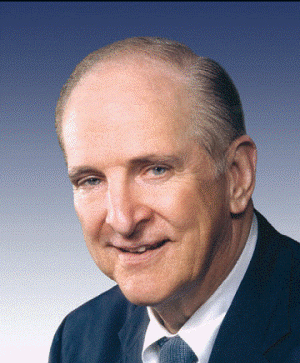 |
| Subcommittee Chair Sam Johnson |
Sep 6, 2012
Democratic Platform On Social Security
During the Republican National Convention, I had quoted what the GOP platform said about Social Security. Here's what the Democratic platform says about Social Security:
We believe every American deserves a secure, healthy, and dignified retirement. America’s seniors have earned their Medicare and Social Security through a lifetime of hard work and personal responsibility. President Obama is committed to preserving that promise for this and future generations.
During their working years, Americans contribute to Social Security in exchange for a promise that they will receive an income in retirement. Unlike those in the other party, we will find a solution to protect Social Security for future generations. We will block Republican efforts to subject Americans’ guaranteed retirement income to the whims of the stock market through privatization. We reject approaches that insist that cutting benefits is the only answer. President Obama will also make it easier for Americans to save on their own for retirement and prepare for unforeseen expenses by participating in retirement accounts at work. ...
In short, Democrats believe that Social Security and Medicare must be kept strong for seniors, people with disabilities, and future generations. Our opponents have shown a shocking willingness to gut these programs to pay for tax cuts for the wealthiest, and we fundamentally reject that approach.
Sep 5, 2012
Ammunition Purchase Still Attracting Attention

The story about Social Security's purchase of 174,000 rounds of ammunition isn't going away. This will fuel conspiracy theorists for years.
Update: This story turned up in Jay Leno's monologue. You first heard about this story here on August 20, 2009. Why did it take so long for everyone else to notice? How long will it take for people to notice the most plausible explanation for purchasing so much ammunition?
Update: This story turned up in Jay Leno's monologue. You first heard about this story here on August 20, 2009. Why did it take so long for everyone else to notice? How long will it take for people to notice the most plausible explanation for purchasing so much ammunition?
Another Field Office To Close

Sep 4, 2012
Processing Time Report
Below is a report showing the average processing time at each of Social Security's hearing offices.This is from the newsletter of the National Organization of Social Security Claimants Representatives (NOSSCR). Click on each page to view at full size.


Despite a lot of work, there are massive differences between offices and regions. Why is it taking almost 100 days longer to get a hearing in the Kansas City region than in the Dallas region? Why is it taking 306 days on average to get a hearing in Greenville, SC but in Columbia, SC, only 103 miles away, it takes 406 days?
Sep 3, 2012
President Eisenhower Signing 1954 Legislation Creating Social Security Earnings Record Freeze For Disability

Apparently, no photo exists of Eisenhower signing the 1956 act that added cash Disability Insurance Benefits to the Social Security Act. Eisenhower signed the 1956 bill with some reluctantance. It appears that he did not want a photograph taken.
Sep 2, 2012

Subscribe to:
Posts (Atom)