Jul 27, 2007

More On Andrew Biggs

An anonymous poster makes an excellent point about Andrew Biggs. Commissioner Astrue has just hired a replacement for Biggs as Deputy Commissioner for Policy, so if Biggs is denied a salary for serving as Deputy Commissioner, he will not be able to draw the salary as Deputy Commissioner for Policy instead.

However, I will venture a guess that the White House would want Commissioner Astrue to come up with some other salary paying slot for Biggs if Congress forbids paying a salary to Biggs as Deputy Commissioner. The White House might even want Biggs paid a bonus to make up for any difference in pay. That is the sort of feistiness or perhaps belligerence that we expect from this President. Would Commissioner Astrue be willing to show enough independence from the White House to say no to this? Finding another way to pay Biggs after Congress cuts off Biggs' salary would certainly not endear Astrue to Congress. If Astrue serves out his term as Commissioner, he will be in office for four years after Bush leaves office.

Andrew Biggs

President Bush repeatedly nominated Andrew Biggs, a huge supporter of privatizing Social Security, to become Deputy Commissioner of Social Security. The Senate repeatedly refused to even consider the nomination, so Bush gave Biggs a recess appointment, good until the beginning of the next Congress in January 2009. The House of Representatives is now threatening to cut off all funding for Mr. Biggs' job as Deputy Commissioner, meaning that Biggs could continue working as Deputy Commissioner, but he could not be paid.

This does not mean that Biggs would have to either work for free or leave Social Security. Social Security's organizational chart shows that Biggs is also Deputy Commissioner for Policy at the Social Security Administration. He would not be getting pay for that job currently, since he is being paid to serve as Deputy Commissioner, but if he lost his paycheck as Deputy Commissioner, presumably he could still draw the Deputy Commissioner for Policy paycheck and still do the Deputy Commissioner job, to the same extent that he is doing it now. I imagine that the Deputy Commissioner for Policy paycheck is a bit less than the Deputy Commissioner paycheck, however.

Is it happenstance that Biggs still has the Deputy Commissioner for Policy job or was someone expecting that Congress would cut off funding for the Deputy Commissioner job and wanted this as a backup?

Also, has Biggs actually been spotted doing the Deputy Commissioner job? I have trouble imagining him chairing a meeting about which new computer system Social Security should buy or about how Social Security will use its scarce budget resources. He just does not seem like that kind of person.

Jul 26, 2007

Fraud Accusation In Arizona

According to the Arizona Republic, Harold Pease, who is pictured here, has been indicted for Social Security fraud. An article in the Arizona Republic about Mr. Pease's beekeeping business led to the charge that he had been earning too much money to stay on Social Security disability benefits.

It seems to me that allowing a newspaper article about his business suggests that Mr. Pease may not have known that he was doing anything wrong.

Jul 25, 2007

Astrue At ALJ Conference

There is an anonymous post on the ALJ Improvement Board from someone who says they heard Commissioner Astrue speak today at the Association of Administrative Law Judges (AALJ) conference. The poster says that Astrue hopes to have new ALJs holding hearings by March 2008, that he expects to hire 700-800 support staff for hearing offices and that he hopes to have 1,200 ALJs by the end of the 2008 fiscal year, which would be September 30, 2008. Astrue also is reported to have said that he expects to be able to restart the senior attorney program soon. He is now planning to have only 10-12 ALJs in the national hearing office. They are also planning to open new hearing offices in Alaska, Michigan, Alabama and Florida (two new offices in the Sunshine state).

First, it is optimistic to expect to have new ALJs on the job by next March. I am not sure Social Security will even have a real budget by then, since the President is threatening to veto the budget bill including Social Security. Hiring always takes longer than you think it will. Second, the number of ALJs to be hired seems to be slipping. Astrue was telling Congress not too long ago that he expected to have 1,250 ALJs on board in 2008. That has already slipped to 1,200. Third, I am extremely happy to hear that the senior attorney program will be restarted. I was very afraid that the Office of Management and Budget would never let this see the light of day. Fourth, I am also happy to hear that this "national" hearing office will be small. This is a bad idea. It should not be done at all, but better small than large. New hearing offices are a great idea. Let me suggest that another hearing office is also needed in Fayetteville, NC. I do not think anyone in this area would disagree with that one.

Washington Post On Social Security Budget And Workforce

Stephen Barr writes the excellent Federal Diary column in the Washington Post. He writes today about Social Security's budget and staffing problems. The whole column is worth reading. Here are a few excerpts:
Staffing at the Social Security Administration will soon be at its lowest level since 1974. The number of disability claims waiting for hearing decisions is at an all-time high.

The drop in staffing and budget constraints have led to crowded waiting rooms and jammed telephone lines at many field offices. For every two field employees who retire or quit, Social Security replaces one.

"It is like a disaster here. We can't do the work we are getting," said WitoldSkwierczynski, an officer of the American Federation of Government Employees who specializes in Social Security field operations. ...

Richard E. Warsinskey, president of the National Council of Social Security Management Associations, said he appreciates that Congress is trying to help. But, he said, the proposed budget still means that Social Security will "be kind of treading water" next year. ...

Partly because of budget constraints, Social Security is closing field offices that serve areas with stable or shrinking populations. Offices are closing in California, Connecticut, New York, Texas and Pennsylvania, Skwierczynski said.

Jul 24, 2007

EAJA -- What's Going On?

My law firm received a direct deposit of an attorney fee under the Equal Access to Justice Act (EAJA) today. That would have been unremarkable six months ago, but things changed and may still be changing.

EAJA fees are available in civil actions filed in the federal courts against federal government agencies if the plaintiff is successful and if the government's position in the litigation was not "substantially justified." Social Security cases generate by far the largest number of EAJA payments. Over the years the EAJA fees came to be paid by direct deposit to the attorney. In the last few months the direct deposits have stopped. The Department of Justice has been insisting that the EAJA fees belong to the client and must be paid directly to the client. This is problematic for attorneys representing Social Security claimants since they may have difficulty collecting the money from the client. Most EAJA fees in Social Security cases are in cases that are remanded by the courts. In remand cases the client has not previously paid any fee or received any money from Social Security. When a desperately poor claimant receives a check from Social Security they usually cash it and spend it quickly.

In the last month or so, there have been signs that the Department of Justice's position on EAJA was softening. There have been signs all along that the Social Security Administration was not interested in litigating on this issue and may have even been sympathetic to the position of attorneys representing Social Security claimants. Of course, there are also signs of great distress and disorganization at the Department of Justice related to the Attorney General.

So what is going on now? Was this EAJA direct deposit some fluke or is it a sign that the Department of Justice has, in effect, told Social Security "Oh, never mind. Just go back to what you were doing"?

Another Field Office Closure

From the Wayne (PA) Independent:
Starting Monday, July 30, residents living in the Carbondale service area, which covers sections of Wayne, Lackawanna, Pike and Susquehanna counties, will be served by the Scranton Social Security office. The seven employees of the Carbondale office will be transferred to the Scranton office.

Terri Lewis, communications director, stated during a telephone interview Thursday that after a review of services offered by the Carbondale office, the Social Security administration believe citizens and employees would be better served in a larger office with more resources.

Jul 23, 2007

The Picture Of Dr. David Gray

Shrink Rap on the Social Security Perspectives blog has linked to a biography of Dr. David Gray, recently hired as Social Security's Deputy Commissioner for Disability and Income Security programs. He is replacing Martin Gerry. Here is a picture of Dr. Gray. I think the picture is worth looking at, since it shows Dr. Gray to be what most people think of as a "disabled" person, although he is clearly not disabled in Social Security terms since he is working.

The problem is that most people's perception, or perhaps prejudice about what constitutes or causes disability is far from reality. Let me list some problems, many of which are somewhat linked, that strongly predispose one to become disabled. Indeed, a combination of two or there of these may be more closely linked to filing a disability claim than being in a wheelchair. Most Social Security disability claims feature one or more of these problems.
  1. Below average intelligence
  2. Low educational attainments
  3. Lack of job skills
  4. Chronic psychiatric problems
  5. Progressive illness, one that gets worse over time, such as diabetes
  6. Medical condition causing chronic pain
  7. Poor medical care
Can Dr. Gray be sympathetic to people who have these problems? Maybe, but being in a wheelchair certainly does not guarantee it.

Jul 22, 2007

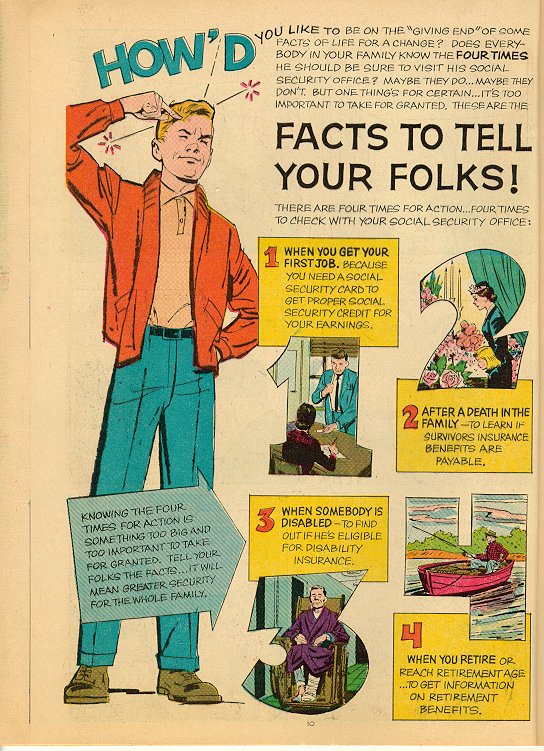
An Image From 1965

White House On Social Security Funding

The White House has issued a long press release threatening to veto the Labor-HHS Appropriations bill that just passed in the House of Representatives. That bill includes Social Security's administrative budget. Only a small part of the press release dealt with Social Security. That part which is reproduced below does not suggest any problem with adding $100 million more in funding for Social Security, as this bill does. Who knows? Maybe, the White House would not gag at even more money for Social Security. By the way, I completely agree with the White House that Congressional paranoia about totalization agreements is ridiculous.
Social Security Administration (SSA)
Limitation on Administrative Expenses. The Administration appreciates the full funding of program integrity activities, which will allow SSA to process more continuing disability reviews and redeterminations of SSI eligibility, saving an estimated $3.6 billion over 10 years.

Totalization Agreements (TAs). The Administration opposes the provision that would prohibit SSA from using administrative funds to develop TAs with other countries that would be inconsistent with current law. SSA would not undertake any such effort if it was inconsistent with current law. Furthermore, there is an established congressional review process for TAs.