
Jan 20, 2017

Jan 19, 2017
Berryhill To Be New Acting Commissioner
From: ^Commissioner
Broadcast
Sent: Thursday, January 19, 2017 9:38 AM
Subject: Announcement - New Acting Commissioner
Sent: Thursday, January 19, 2017 9:38 AM
Subject: Announcement - New Acting Commissioner
To: All SSA and DDS Employees
Subject: Announcement - New Acting
Commissioner
In my farewell message last week, I let you
know that I advised the President that I will be leaving my position as Acting
Commissioner at the end of his term on January 20th. Upon my
departure, Nancy Berryhill, Deputy Commissioner for Operations (DCO), will serve
as Acting Commissioner based on the Agency's succession plan. I have
worked closely with Nancy for many years and have the utmost respect for her as
a leader.
Nancy has a distinguished career of over 40
years with SSA. Prior to assuming the position of DCO, she was the
Regional Commissioner of the Chicago region. Nancy has held numerous management
and technical positions in SSA. Her work and
achievements consistently demonstrate professional excellence, exceptional
leadership, integrity, and commitment to public service.
Please join me in wishing Nancy well as she becomes Acting Commissioner of
Social Security.
Carolyn W. Colvin
Acting Commissioner
Jan 18, 2017
No More Discipline For Refusing To Watch LGBT Video
From WDWS:
A Social Security Administration employee who feared for his job after refusing in June to watch a required workplace-diversity video about the LGBT community has not been disciplined any further and thinks the outcome of the presidential election may have played a part in that.
David Hall, 42, of Tolono said he believes President-elect Donald Trump's win in November is partly why no punishment followed a two-day August suspension without pay for his continued refusal to watch the video, which he believes violates his religious beliefs. ...
Since then, Hall said, another agency employee in Iowa became aware of him through media coverage and contacted him, saying he had also refused to watch the video.
But, as Hall understands it, that employee's bosses didn't indicate the video was mandatory and didn't discipline him at all. ...
Jan 17, 2017
Regs On Evaluation Of Medical Evidence On Hold
On January 5 the Office of Management and Budget (OMB) cleared Social Security's packet of final regulations changes on the evaluation of medical evidence. Ordinarily, once regulations are approved by OMB, they're published in the Federal Register within a few days but these final regulations have still not appeared in the Federal Register. I think it's unlikely that these will be published at this time. If they were published, the incoming Trump administration would probably prevent them from coming into effect until they could be reviewed. These regulations may end up exactly the same after they're reviewed but it may be many months until that review is complete.
Update: I spoke too soon. These will be published in the Federal Register tomorrow. However, this may make little difference. These regulations cannot come into effect until 30 days after publication in the Federal Register. The new President is likely to issue an order preventing any new regulation from coming into effect until it has been reviewed by the new administration.
Update: I spoke too soon. These will be published in the Federal Register tomorrow. However, this may make little difference. These regulations cannot come into effect until 30 days after publication in the Federal Register. The new President is likely to issue an order preventing any new regulation from coming into effect until it has been reviewed by the new administration.
Jan 15, 2017
Representing Social Security Disability Claimants Is Just A Laughfest
This happened some years ago. A client
told me about being in the emergency room several times recently with
chest pain so I wrote to request the emergency room reports. The reports came in. The client
had not been admitted. The chest pain seemed to be esophagitis. In case
you don't know, esophageal pain is quite common and it can seem very, very
much like angina. It sometimes seems to me that everyone eventually
ends up in the emergency room because of esophagitis.
There was another emergency room report that I wasn't expecting concerning a different
problem. My client wanted help removing a vibrator that was stuck up his
anus. Seriously. A little experimentation with the help of his girlfriend according to the report. We respect our clients but we got a chuckle out of
that one until we got a call later that day saying that the client had
just died of a heart attack. Seriously.
Jan 14, 2017
How Did He Get Away With It For So Long?
From the AP:
A former Tampa Bay area postal employee faces up to 15 years in federal prison for stealing more than $2 million in Social Security checks.
A U.S. Attorney's Office news release says jurors found 48-year-old Stacy Darnell Mitchell guilty Wednesday of theft of government property and theft of mail. His sentencing date hasn't been set.
Mitchell was a mail handler for more than 15 years at the processing and distribution center in St. Petersburg. Authorities say Mitchell stole more than 3,000 Social Security benefit checks from the facility from January to October 2012. The checks were sold and cashed at various convenience stores and check cashing businesses.
Jan 13, 2017
A Farewell Message
From: Colvin, Carolyn
Sent: Friday, January 13, 2017 11:49 AM
Subject: Farewell Message from the Acting Commissioner
TO:
All SSA and DDS Employees
I
want you to know that I have advised President Obama that I will be leaving my
position as Acting Commissioner of Social Security at the end of the
President’s term on Friday, January 20th.
I
have devoted my life to public service, serving in positions at all levels of
government, but serving here with all of you has been the greatest honor of my
life. The times I have treasured the most are the times I have been able
to visit your offices to speak with you about the important work we do, and
about your dreams and aspirations. Those are some of my most joyous and
inspirational times at SSA. You are truly the greatest public servants in
government.
Social
Security is the most important social program ever implemented in this
country. The agency distributes almost $1 trillion to 65,000,000 people
each year. Millions of our fellow Americans rely on these benefits and
the services we provide. Indeed, many of our seniors would be in poverty
if they did not receive their Social Security benefits each month.
Never
forget, you make a positive difference every day in the lives of the tens of
millions of people who visit our offices, call us on the telephone, or rely on
our online services each year. We can be proud of our numerous
accomplishments which represent our shared legacy. I cannot express the
pride I feel in having been part of this incredible work. Remember, each
day, thousands and thousands of individuals may experience, for even a moment,
hope, and if we are lucky, a better life, because of something you have been
able to do for them.
I
want to personally thank you again for the outstanding service you provide and
for the support and guidance you have given me. I wish you much happiness
and success in all of your future endeavors.
Carolyn
OIG Report On Repeated Overpayments
From a recent report by Social Security's Office of Inspector General (OIG):
By the way, note that 39% of the overpayments to Title II recipients and 47% to SSI recipients weren't the fault of the claimant. Let that sink in. The claimants were reporting earnings and Social Security didn't do what it was supposed to do a lot of the time. You also have to wonder how many of the cases where OIG wants to punish claimants are cases where the claimant reported the earnings but Social Security never kept a record of them reporting earnings. That happens. If you just look at computer records, it looks like the claimants were bad actors but when you start talking to the claimants, it's not so clear. This is just one of the reasons why Social Security isn't all that interested in imposing punishments.
But, hey, this kind of report pleases Congressional Republicans and that's what it's all about. Right?
We found 70 (61 percent) of the Old-Age, Survivors and Disability Insurance (OASDI) beneficiaries and 59 (53 percent) of the Supplemental Security Income (SSI) recipients in our sample [of claimants who already had a history of three or more earnings related overpayments] were repeatedly overpaid because of their earnings. We believe SSA could have found these 129 individuals at fault for causing or contributing to the overpayments because of their repeated failure to comply with Agency earnings reporting requirements. SSA also could have further developed these cases to determine whether punitive actions could have been used as a deterrent against future overpayments. However, we found the Agency did not apply these actions to any of the individuals in our sample.
Based on our sample, we project SSA overpaid
- 49,420 OASDI beneficiaries almost $966 million and
- 94,480 SSI recipients almost $924 million.
As of February 2016, we estimate SSA had not collected almost $178 million of these OASDI overpayments and more than $447 million of these SSI overpayments.Social Security had identified these overpayments and has had some success in collecting them. What more does OIG want? They say they want people punished. There are provisions in the Social Security Act that allow punishment. I've noticed that OIG really likes to recommend that others use those provisions to punish people. However, when OIG has the opportunity to punish people itself, they don't seem to me to be quite so bloodthirsty. It's real people and things get messy. The overpayments are often small, the claimants not too bright and the fault not so clear. Punishment seems like overkill.
By the way, note that 39% of the overpayments to Title II recipients and 47% to SSI recipients weren't the fault of the claimant. Let that sink in. The claimants were reporting earnings and Social Security didn't do what it was supposed to do a lot of the time. You also have to wonder how many of the cases where OIG wants to punish claimants are cases where the claimant reported the earnings but Social Security never kept a record of them reporting earnings. That happens. If you just look at computer records, it looks like the claimants were bad actors but when you start talking to the claimants, it's not so clear. This is just one of the reasons why Social Security isn't all that interested in imposing punishments.
But, hey, this kind of report pleases Congressional Republicans and that's what it's all about. Right?
Jan 12, 2017
Chevron In Danger?
From TPM:
… Yesterday, the House of Representatives passed a bill that could cripple the ability of government to regulate private industry.
The bill modifies the Administrative Procedure Act …
The Supreme Court ruled in 1984 that the courts could only overturn rulings that were “arbitrary and capricious, an abuse of discretion.” In other words, the courts would have to defer to the regulatory agencies in finding whether a ruling was justified. But the Republicans in the House passed a law that would allow the courts to rule without giving deference to the regulatory agencies. A Republican court could, for instance, overrule decisions of the Food and Drug Administration or the Environmental Protection Agency on concocted Constitutional grounds – say, by arguing that it violated the “takings” clause of the Constitution. That could cripple the regulatory agencies. ...Apparently, this would end the Chevron deference. How could this affect Social Security? It would make it far easier to challenge the agency's interpretation of the statutes. Any change in the APA is hugely important.
Interesting Question
I've been doing Social Security work since 1978 so it's not often I get a question that I haven't heard before but here's a new one on me. Let me explain some background first. There's a 24 month waiting period for Medicare after Social Security Disability Insurance Benefits begin and that waiting period only begins after the five month waiting period for cash benefits to start. Yes, it's brutal. As long as the waiting periods are, many cases are delayed long enough that the claimant is entitled to back Medicare benefits. To get Medicare Part B, the part that pays for outpatient medical treatment, you have to pay monthly premiums. What happens in cases with retroactive Medicare entitlement is that the Medicare Part B doesn't go back unless you pay the back premiums. The question is can you take the retroactive Part B for only part of the time period for which you're eligible for it? This claimant's case had gone on for a very long time. The period of retroactive Medicare entitlement is about 30 months. The claimant had health care insurance until about nine months ago. She feels she won't get much value out of retroactive Medicare Part B until her health care insurance ended so she only wants the retroactive Medicare Part B for the last nine months instead of the entire 30 month time period. The difference in retroactive Part B premiums is over $2,000 so this isn't an academic question. Does anyone have experience with this question?
Social Security Headcount Goes Down
The Office of Personnel Management
(OPM) has posted updated figures for the number of employees at the Social Security Administration:
- September 2016 64,394
- December 2015 65,518
- September 2015 65,717
- June 2015 65,666
- March 2015 64,432
- December 2014 65,430
- September 2014 64,684
- June 2014 62,651
- March 2014 60,820
- December 2013 61,957
- September 2013 62,543
- June 2013 62,877
- March 2013 63,777
- December 2012 64,538
- September 2012 65,113
- September 2011 67,136
- December 2010 70,270
- December 2009 67,486
- September 2009 67,632
- December 2008 63,733
- September 2008 63,990
Jan 11, 2017
Paper Statements Will Go To Few People
From Social Security's own blog:
We made some difficult decisions because of these latest budget limits. During the past year, we began a hiring freeze that will reduce our staff to the lowest level since FY 2013. We use a lot less overtime now, which affects our ability to reduce critical backlogs. Over a million people are waiting for a hearing to see if they are eligible for disability benefits.
Today, we are taking another cost-saving step. We will mail fewer paper Social Security Statements. Paper Statements will only be sent to people age 60 and over, who are not getting benefits and don’t have a my Social Security account. This will bring down the costs of processing and mailing paper Statements by $11.3 million in FY 2017.This change is already drawing attention from Michael Hiltzik at the L.A. Times, Phillip Moeller at PBS and Mary Beth Franklin at Investment News.
Number Drawing Disability Benefits Declines 1.13% In 2016
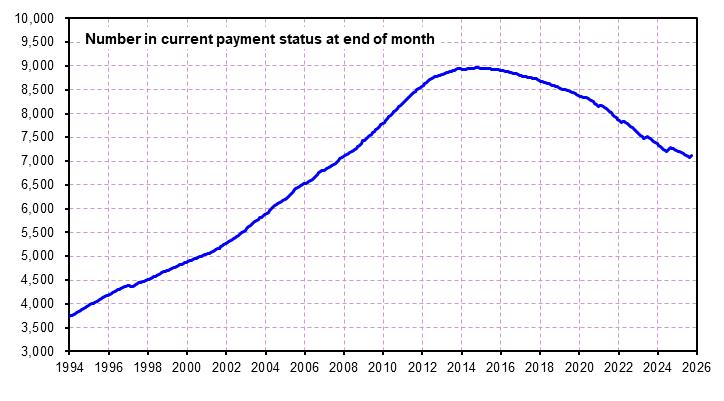
The final numbers for calendar year 2016 are in. By the end of 2016 there were 1.13% fewer people receiving Social Security disability benefits than at the end of 2015. That's 100,694 people. This is happening at a time when the aging of the baby boom generation should still be causing increasing numbers of people receiving disability benefits.
There are three main reasons this is happening. It's harder to get approved for disability benefits. It takes longer to get approved. Because it's harder to get approved and because it takes longer, many people are discouraged from filing claims in the first place.
There are three main reasons this is happening. It's harder to get approved for disability benefits. It takes longer to get approved. Because it's harder to get approved and because it takes longer, many people are discouraged from filing claims in the first place.
Jan 10, 2017
Proposed Rules On Attorney Regulation Withdrawn
The Social Security Administration has withdrawn its set of proposed final regulations on Revisions to Rules of Conduct and Standards of Responsibility for Appointed Representatives from review by the Office of Management and Budget. This does not mean that this proposal is dead. It can be resubmitted by Social Security after the change of administration, with or without change.
Attorney Fees Hold Steady
Social Security has posted its final numbers
on fees paid to attorneys and others for representing Social Security
claimants in 2016. The total was $1.093 billion, down only slightly from $1.094 billion in 2015. Fees are down $336 million, or 23%, from the peak in 2010.
All attorneys who practice Social Security law face considerable
economic pressure. The attorney fee provisions of the Social Security Act were designed to
allow claimants to have representation. This right could be effectively
eliminated over coming years unless something changes. One important
way that the Acting Commissioner of Social Security could assure that
claimants don't lose their right to representation is to increase the
cap on Social Security attorney fees. It's currently $6,000. The Social
Security Act allows the Acting Commissioner to raise this to adjust for
inflation but does not require that she do so. If adjusted for
inflation, the cap would now be over $7,000. It's past time to raise the
cap.
Every time I write about attorney fees, I get the response from some Social Security employees that attorneys who represent claimants are lazy, that they do nothing for the money they're paid. Those who would post this need to ask themselves the question "If representing Social Security claimants is such easy money, why don't I leave my job with the agency and jump on this gravy train?" After all, who goes to law school with the intention of never representing a real live client? Get out there and show the world how it should be done!
Social Security employs thousands of attorneys but hardly a one of them has left Social Security to represent Social Security claimants in recent years. What does that tell you?
And by the way, when I post about attorney fees I usually get responses from some Administrative Law Judges that go something like "When I was in private practice, I spent hundreds of hours doing depositions and meeting with my client and other witnesses in each individual case. Social Security attorneys don't do anything like that so they're worthless." Those who post this tend to forget that they or their firms were being paid tens if not hundreds of thousands of dollars a case. You try spending hundreds of hours on each Social Security case when the total possible fee is no more than $6,000 and see how long you last. The challenge in representing Social Security claimants is doing a professional job when economics require you to represent lots of clients. Give it a try and find out for yourself just how easy that is.
Jan 9, 2017
Attorney User Fee Remains At 6.3% -- How About Liens Instead?
The fee paid by attorneys and others who receive direct payment of fees for representing Social Security claimants will remain at 6.3% of the fee in 2017 subject to a $91 cap per case. Social Security says this is their actual costs. Those of us who represent Social Security claimants feel this is absurd, that the agency's true costs are vastly less, and that the fee is nothing more than a thinly disguised tax.
By the way, whenever I post about fees, I get the response that "real attorneys" collect their fees directly from their clients. That's bunk. There are three basic ways that attorneys collect fees. One is to collect the entire fee up front. A second is to bill clients on a pay as you go basis. This works only when you're representing corporations or wealthy individuals. If the client stops paying, the attorney withdraws from the case. Neither requiring payment up front or on a pay as you go basis is practical in Social Security cases because the claimants are usually too poor. The third way is contingent fees. The attorney takes a portion of the settlement or award if the client ultimately receives one. In such cases, the attorney has a lien on the settlement or award. The client cannot avoid paying up. However, the Social Security Act prohibits most liens on benefits. Those who would want to repeal attorney fee withholding without allowing an attorney a lien on back benefits aren't trying to make attorneys collect their fees like "real attorneys." Those "real attorneys" who represent claimants on a contingent fee basis have a lien giving them an assurance of receiving a fee. If you want to repeal withholding but give me the same lien as "real attorneys" have when they represent clients on a contingent fee basis, I'm with you. How about it? Also, by the way, I'm not aware of any other situation where attorneys have to pay a fee for their lien on a settlement or award.
Jan 7, 2017
Johnson To Retire From Congress At End Of 2018
Congressman Sam Johnson, who has been Chairman of the House Social Security Subcommittee, has announced that he is retiring from Congress at the end of 2018. He is 86 years old. I expect he will remain Chairman of the House Social Security a Subcommittee for this Congress.
Jan 6, 2017
No Announcement Of Colvin Resignation
Probably there's nothing to make of it but there's been no announcement that Acting Social Security Commissioner Carolyn Colvin is resigning. There had been several reports that she was not planning to stay in her job into the next administration. It's only two weeks to inauguration day. If she has already resigned effective on some day in the future, I would expect an announcements from Social Security and a press release from the White House thanking her for her service.
Colvin's term as Deputy Commissioner of Social Security ended some time ago but the law allows her to continue in office until a successor is confirmed. She can also stay as Acting Commissioner until a new Commissioner is confirmed unless the new President designates someone else to be Acting Commissioner.
Regulations On Evaluation Of Medical Evidence Advance
The Office of Management and Budget (OMB) has cleared Social Security's proposed final regulations on evaluation of medical evidence. Here is the agency's summary of the regulations:
We are proposing several revisions to our medical evidence rules. The proposals include redefining several key terms related to evidence, revising our list of acceptable medical sources (AMS), revising how we consider and articulate our consideration of medical opinions and prior administrative medical findings, revising who can be a medical consultant (MC) and psychological consultant (PC), revising our rules about treating sources, and reorganizing our evidence regulations for ease of use. These proposed revisions would conform our rules with the requirements of the Bipartisan Budget Act of 2015 (BBA), reflect changes in the national healthcare workforce and in the manner that individuals receive primary medical care, simplify and reorganize our rules to make them easier to understand and apply, allow us to continue to make accurate and consistent decisions, and emphasize the need for objective medical evidence in disability and blindness claims.
These may now be published in the Federal Register. However, the Administrative Procedure Act provides that the regulations cannot come into effect for at least 30 days after publication. There will be a new President by then. We do not know for sure what the new President will do but it's a good bet that all regulations which have been approved but which have not yet come into effect will be put on hold pending review by the new administration and that review may not be complete until there's a new Commissioner. It's not that these new regulations are likely to be unpopular with the new administration but it may still take months before they come into effect and they might be modified. But, then again, who knows what to expect out of the Trump Administration?
Subscribe to:
Posts (Atom)