Feb 27, 2018

What Constitutes A Signature?

     I posted this about three years ago:
The Social Security Administration allows electronic signatures on its Form SSA-827, "Authorization To Disclose Information To The Social Security Administration." The agency allows most claims and appeals to be filed online. What about Form SSA-1696, "Appointment of Representative." What about fee agreements between attorneys and their clients? Does Social Security have a policy on acceptance of electronic signatures on these forms? Are "wet" signatures still required?
     I never got any definitive response. Social Security certainly has policies on the subject of what constitutes a signature when it's for their convenience. Wouldn't it be appropriate for the agency to issue some guidance on this for attorneys and others who represent claimants?  Isn't serving the public what the agency is supposed to be doing or are attorneys not part of the public?

Feb 26, 2018

I Don't Vouch For This

     There's a video posted on Facebook that allegedly shows a security guard physically abusing a visitor to a Social Security field office. I hesitate to post this since I don't know the person who recorded it or what happened before this video was recorded. I am pretty sure, at least, that this did transpire at a Social Security office. You can see what appears to be the obverse side of a Social Security logo in the window. I don't know where this was recorded but the Facebook account belongs to a woman who lives in Phoenix.

SEI Problems

     The Earned Income Tax Credit (EITC) is a fine way to help low income workers. The problem with the EITC is that you must have some income to get the credit. This creates a temptation to create fictitious income in order to get the credit. 
     Social Security's Office of Inspector General (OIG) has issued a report on the effects of correcting its earnings records to remove improperly recorded Self Employment Income (SEI). The amount removed from earnings records is not insignificant -- around $200 million a year. Most of it is removed for reasons other than fraud -- routine mistakes in reporting income such as an incorrect Social Security number.
     While some SEI is removed due to EITC fraud, there's no doubt that there's plenty more fraud that's never identified. A significant part of the EITC fraud, perhaps most of it, isn't the fault of the person in whose Social Security number the SEI was recorded. The way this works is that a crook finds out that a person isn't working due to age or illness and wouldn't be filing a tax return. It may be a relative or friend. They obtain the Social Security number and file a tax return in that person's name listing fictitious SEI. The crook asks that the tax refund go to a bank account he or she controls. The elderly or sick person whose Social Security number was used never becomes aware of the fraud. The federal government never finds out about the EITC fraud in most cases but even if they do the amount of money is so small so they don't expend much effort tracking down the crook. There are also persistent reports that some unscrupulous tax preparers are involved in EITC fraud in various ways.
     Correcting earnings records because of misreported SEI, whether accidental or fraudulent, is not an insignificant burden for Social Security. It's also causing incorrect benefit payments because of inflated income on earnings records although the report doesn't try to estimate how much money this would be.

Feb 25, 2018

Let's Bury The "Notch Baby" Controversy

     I can't believe it. The largely bogus "notch baby" controversy has generated a new press mention. I hope this is the last one.

Feb 23, 2018

First Briefs Filed In Lucia

     The parties to the Lucia v. SEC case pending before the Supreme Court have filed their briefs on the merits. Lucia concerns the constitutionality of Administrative Law Judges under the Appointments Clause of the Constitution. Both briefs argue that they are unconstitutional. Under prior Presidential Administrations the position had been that they were constitutional. That changed after Donald Trump decided to be guided in all matters of constitutionality by the Federalist Society. There will be an amicus curiae appointed by the Court who will argue for the position that they are constitutional. That brief hasn't been filed yet. Neither of the briefs filed so far makes mention specifically of Social Security ALJs but both are careful to note that SEC ALJs preside over adversarial adjudications. I don't see that that has anything to do with the scope of the authority exercised by the ALJ, but that's the distinction the briefs implicitly make.

Underpaying Widows

     From a recent report by Social Security's Office of Inspector General (OIG):
Objective: To determine whether the Social Security Administration (SSA) had adequate controls to inform widow(er) beneficiaries of their option to delay their application for retirement benefits.
Background: An application for retirement or widow(er)’s benefits is an application for both benefits, unless it is restricted. When a widow(er)’s benefit is higher, claimants may delay filing their retirement application up to age 70 to increase their retirement benefits.
Claimants may limit the scope of the application to exclude retirement benefits to maximize the amount of future benefits, including the effect of delayed retirement credits before age 70.
Findings: SSA employees must explain the advantages and disadvantages of filing an application so claimants can make an informed filing decision. However, the decision to file belongs solely to the claimant. SSA employees must discuss and document any unfavorable filing decisions. ...
SSA needs to improve controls to ensure it informs widow(er) beneficiaries of their option to delay their application for retirement benefits. Based on our random sample of 50 beneficiaries, we estimate 11,123 would have been eligible for a higher monthly benefit amount had they delayed their retirement application until age 70. Of these, we estimate SSA underpaid about $131.8 million to 9,224 beneficiaries who were age 70 and older. In addition, we estimate SSA will underpay an additional 1,899 beneficiaries who were under age 70 about $9.8 million, annually, beginning in the year they attain age 70. 
We did not find any evidence SSA had informed claimants of the option to delay their retirement application when they applied for benefits, as required. We also found that SSA did not have systems controls in place to alert its employees when they should inform widow(er)s of their option to delay their applications for retirement benefits. ...
     So, what are we going to do about this, Social Security? No, I don't mean what you're going to do about future cases. I'm asking what you're going to do about all these cases where beneficiaries have already been underpaid because they weren't properly advised?

Feb 22, 2018

No Prosecution For Alleged Rep Payee Fraud

     A Richmond television station is reporting that the U.S. Attorney's Office for the Eastern District of Virginia has declined to prosecute in the case of an institutional Social Security representative payee who is alleged to have taken money from 300 mentally disabled people. The business in question is closed and the beneficiaries involved all have new representative payees but no one seems to know where the money went.

They Knew It Would Be An Unpopular Decision

U.S. Rep. Gwen Moore (D-Milwaukee) and Milwaukee Mayor Tom Barrett on Wednesday denounced plans by the Social Security Administration to close its Mitchell St. field office on the city's south side. ...
At a news conference outside the former Forest Home Library, Barrett said he did not hear about the agency's decision to close the Mitchell St. office until January and that the city has offered the former library at 1432 W. Forest Home Ave. for a location. ...
Moore, whose district includes the area served by the office, said the proposal would disperse its Spanish-speaking employees currently serving the poor and largely Hispanic residents of the neighborhood to offices that are hard to reach by bus.
She also said the agency has not made serious attempts to find suitable replacement locations and that she and other public officials were not notified of the closure until the decision had already been made.
"They did not include me or other city officials in the decision," Moore said.
"It seems like they contacted us after they had already made this decision." ...
Jessica LaPointe of the American Federation of Government employees read a statement she said was from employees at the Mitchell St. office saying they were "blindsided" by news of the closure and told to keep quiet about it. ...

Feb 21, 2018

Waiting In Denver

     From KUSA in Denver:
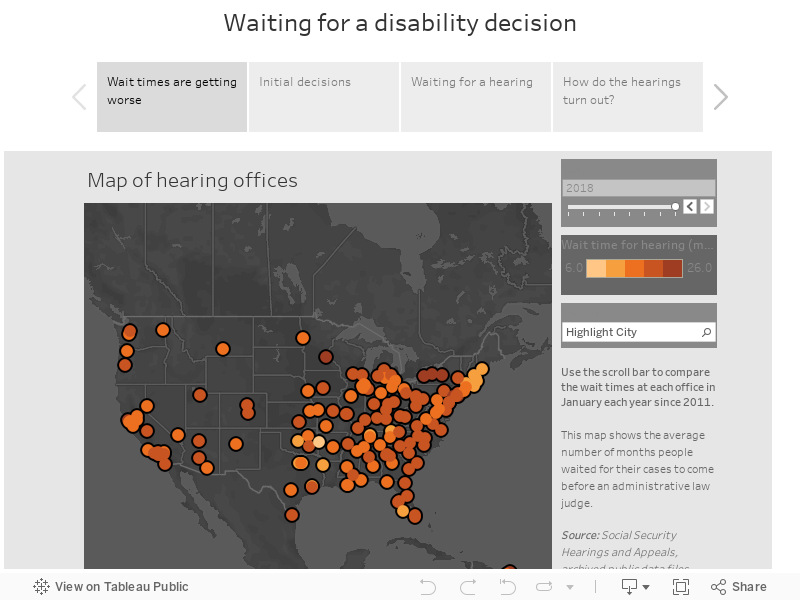
Americans with legitimate disability claims are routinely denied benefits under the Social Security Disability Insurance program, then find themselves trapped waiting months, even years, to get a decision on an appeal ...

[W]hile more than 1 million people wait for their appeals to be heard nationwide, many lose their savings or retirement funds, others their homes, sometimes ending up on the streets. 
Thousands have died while waiting for a hearing, according to the Office of the Inspector General.

“It’s this major injustice,” said Denver disability attorney, Will Viner. “What has happened with the increase in the backlog is people are losing their house, unable to pay for food and shelter. In the past year we have had nine clients pass away.”...
And the delays are getting worse. 
In Denver for example, the average wait time to come before a judge was 18 months in January 2018. In the same month of 2014, the wait was 11.5 months.  ...
     I love the graphic that someone did for KUSA. Good work.