Aug 1, 2018

71% Overpayment Rate

     From Work-Related Overpayments of Social Security Disability Insurance Beneficiaries: Prevalence And Descriptive Statistics, a study by several researchers for the Mathematica Center for Studying Disability Policy:
Work-related overpayments occur when the Social Security Administration (SSA) issues a monthly benefit to which an individual is not entitled because of engagement in substantial gainful activity. ... 
We found that: 
  • 1.9 percent of all DI [Disability Insurance] beneficiaries in our sample were overpaid due to work in one or more months during the three-year study period. 
  • Among DI beneficiaries with sufficient earnings to put them at risk of a work-related overpayment, 71 percent were overpaid. 
  • Work-related overpayments lasted for a median of nine months. 
  • Work-related overpayments accrued to a median of over $9,000.
      71% of the time that a Social Security Disability Insurance Benefits recipient returns to work for long enough at enough pay that his or her benefits should be reduced those benefits aren't actually reduced and there's an overpayment of benefits? That's terrible. It's obvious that there are systemic problems. You can't just blame claimants for this high a rate of overpayments. There are undoubtedly many reasons for this situation but the incredible complexity of the rules applied in cases where beneficiaries return to work have to be a major part. I also think it's too difficult to report return to work.
     I'll make one simple suggestion which would probably help and it could be implemented without changing any laws. Send a yearly mailer to each person drawing disability benefits each January asking whether they have earned money in the preceding year. If they reply that they have, follow up with them to get the details. If they have worked but remain eligible for benefits at the time, send them quarterly mailers for at least the next couple of years and follow up on the responses. I'll admit that there's one huge problem with my suggestion. Social Security lacks the manpower to deal with the responses they would receive. I'll admit that it's also possible that it wouldn't be cost efficient since only 1.9% o benefits recipients are affected. Got any better ideas?

Jul 31, 2018

SSA Failing To Recover Net Out Some SSI Overpayments And Underpayments

     From a recent report by Social Security's Office of Inspector General (OIG):
... To recover an outstanding SSI overpayment, SSA can withhold the entire prior-month underpayment due a recipient up to the balance of the overpayment. SSA defines underpayments that are due for months before the month SSA identifies them as prior-month underpayments. ...
SSA did not always follow its policy of withholding SSI prior-month underpayments from outstanding SSI overpayments. Specifically, SSA did not appropriately withhold more than 6,000 prior-month underpayments to recover outstanding overpayments. This occurred because SSA employees did not take the necessary manual actions in SSA’s systems to ensure overpayment recovery. Had SSA followed its policy, we estimate it could have recovered approximately $44 million in outstanding overpayments from nearly 125,000 prior-month underpayments it paid to SSI recipients during CYs 2015 and 2016. ...

Jul 30, 2018

Lucia Doesn't Pose A Catastrophic Threat

     The prospect of huge numbers of Appeals Council remands as a result of the Supreme Court decision in Lucia v. SEC worries a lot of people. It would certainly add to the severe backlogs at the hearing level but let's not get carried away. As of the end of June there were 89,157 cases pending at the Appeals Council. So far this fiscal year, Administrative Law Judges are disposing of an average of 60,746 cases per month. This means that if every case pending at the Appeals Council is remanded for a new hearing as a result of Lucia, the backlog at the hearing level would increase by about one and a half months. Certainly, any increase in the backlog is undesirable but a one and a half month increase in the backlog is hardly catastrophic. Ending the backlog at the Appeals Council level would be a good side effect. Appeals Council employees who suddenly lack regular job duties could help with the decision writing backlog at the hearing level. Large numbers of Lucia remands wouldn't destroy the system -- not that the system is anything to brag about.

Jul 29, 2018

Are ALJs A Bunch Of Liberal Democrats?

     Based on limited experience, Paul Mirengoff believes almost all Administrative Law Judges (ALJs) are liberal Democrats, a group he certainly doesn't want hearing cases.
     Some real ALJs beg to differ.
     I don't talk much with ALJs about politics and never at a government office. I rarely interact with ALJs other than at a Social Security office. My impression is that the veterans preference assures that ALJs as a group aren't particularly liberal, particularly for lawyers. Of course, it's more than possible that Mr. Mirengoff regards anyone who doesn't wear a MAGA cap regularly as a liberal Demicrat.

Jul 28, 2018

SSA Failing To Initiate Overpayment Withholding On A Timely Basis In Some Cases

     From a recent report by Social Security's Office of Inspector General (OIG):
SSA did not always appropriately withhold overpayments from individuals receiving OASDI [Old Age, Survivors and Disability Insurance] or SSI benefits. We reviewed a sample of 50 OASDI beneficiaries and 50 SSI recipients who were receiving a monthly benefit and had a total outstanding overpayment balance greater than $1,000. We found SSA missed opportunities to recover overpayments from 31 of these individuals’ benefits (28 OASDI beneficiaries and 3 SSI recipients). ...
Had SSA initiated withholding timely, we estimate it could have already collected over $114 million in overpayments from almost 25,000 individuals. ...

Jul 27, 2018

Senators Object To Treatment Of Employee Unions

     From the Baltimore Sun:
Maryland’s U.S. senators say the Social Security Administration is demonstrating “hostility towards its workforce” in the way it is implementing recent executive orders signed by President Donald J. Trump.
Trump signed the orders in May with the stated goals of promoting accountability, rooting out poor performers and negotiating union contracts more advantageous to taxpayers and the federal government.
But labor groups have characterized the orders, which reduce the time available for union business, as an attack on long-held civil service protections.
The Baltimore-based SSA has gone beyond the orders’ reach and is trampling workers’ rights, Democratic Sens. Chris Van Hollen and Ben Cardin said in a letter Thursday to acting commissioner Nancy A. Berryhill and other officials. ...

The Argument For Trump's Order On Federal Employee Unions

     From Bob Gilson writing for FedSmith:
I admit to fascination at the statements made by many union representatives in response to recent Executive Orders addressing their use of government time, space, equipment, and services.
When the Civil Service Reform Act went into effect in 1979, no one on either side of the aisle in either house on the Hill or down the street on PA Avenue would have seen as remotely possible the complete payment of all employee/union representatives, some getting 100% of their work time doing union work. Also incredible in 1979 would have been the current practice in many Agencies of paying for all union communications, computing, office space, meeting space and other costs. ...
     Gilson goes on to detail the facts that some union money has been used to pay for a lobbyist (a pittance by D.C standards) and that union dues have paid for only a fraction of the union's true operating costs. It's directed specifically at the union local that represents most Social Security employees. It's a harshly anti-union piece but there's certainly an argument to be made in favor of Trump's order on federal employee unions.

LTD Industry Take On Social Security Subcommittee Hearing

     People like me who represent disability claimants may think that we're the only ones interested in how the Social Security Administration handles appeals of disability claims but that's not right. Some non-profits are interested but so are insurance companies handling long term disability (LTD) benefits.  LTD is generally reduced because of Social Security disability benefits received giving the LTD insurers a huge interest in the adjudication of Social Security disability claims. The more claims get approved, the less their liability.
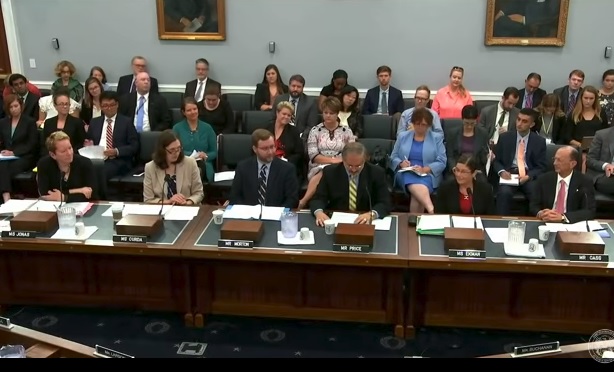
     Allison Bell has written an article summarizing what took place at this week's hearing before the Social Security Subcommittee, apparently for people in the LTD industry.