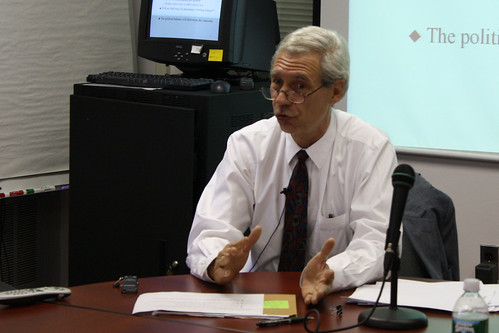
- W. Lee Hammond, President of the Board, AARP
- Ethel Zelenske, Co-Chair of the Social Security Task Force, Consortium for Citizens with Disabilities
- Kelly Ross, Deputy Policy Director, AFL-CIO
- Sylvester J. Schieber, Ph.D., Independent Consultant, New Market, Maryland
- Virginia Reno, Vice President for Income Security, National Academy of Social Insurance
- Nancy Altman, Co-Director, Social Security Works
Jul 13, 2010
House Social Security Subcommittee Hearing Witness List Released
Amazing Naivete
One [Social Security] reform that could win bipartisan support would, over time, raise the Social Security retirement age to 70. An extension of retirement age to 67 from 65 was pushed in 1983 by the Greenspan Commission, along with a boost in the income base for payroll taxes. President Reagan backed the changes and Congress enacted them.
A second reform, bolder and more controversial, would means-test Social Security, gradually slowing the growth of benefits for the more affluent but sparing those with lower incomes. The model for this is the Pozen plan, the brainchild of Robert Pozen, a former vice chairman of Fidelity Investments and influential Social Security reformer.
I am sure that I have my illusions about Republicans but nothing tops Republican naivete about Democrats. People who should know better are misled by the fact that President Obama appointed Erskine Bowles, nominally a Democrat, to the deficit reduction commission. Bowles is not representative of Democrats in his home state of North Carolina (which is one of the reasons he could not get elected to public office in North Carolina), much less Democrats nationally. Means testing of Social Security has zero chance of adoption and raising the retirement age to 70 has very, very little chance of adoption. I do not think you could get even a majority of Congressional Republicans to vote, publicly, for either one. If you can imagine Barack Obama campaigning for either one, you just might be a Republican.
Plans For Social Security 75th Anniversary?
The National Committee to Preserve Social Security and Medicare isn't waiting. They have an extensive commemoration planned.
People Are Noticing
Jul 12, 2010
Current Picture Of A Building Where A New Hearing Office Is Supposed To Open In Early 2011
The Problem Solver Gets It Done
Fran Lubelchek and the Social Security Administration have a long and twisted history.
When the 70-year-old retired schoolteacher began receiving benefits five years ago, the government miscalculated her monthly payment. By the time it realized the error years later, Social Security had overpaid the Northbrook resident by roughly $14,000.
To pay the money back, Lubelchek and Social Security worked out a deal. Because she received a teacher's pension, her correct monthly Social Security payment was small, about $100. To repay the $14,000, Lubelchek agreed to receive no monthly benefit until she was almost 85.
She thought she had everything squared away, but her relationship with Social Security took another odd turn after her husband, Harvey, died in February.
In March, April and May, Social Security continued to deposit her late husband's $1,576 monthly benefit check into the couple's joint account. Then in May, the agency removed the three payments, all $4,728, from Lubelchek's bank account without saying a word. ...
After visiting her local Social Security office repeatedly and failing to get things straightened out, Lubelchek e-mailed What's Your Problem?
"I never realized that the SSA could withdraw significant money from a checking account without permission from the account holder," she said.
Lubelchek said that on her last visit to her Social Security office, she was told she was entitled to more than $1,000 a month in benefits based on her late husband's account, but it was unclear when those payments would begin.
"The woman said, 'I can't do anything here,'" but promised to make it a priority, Lubelchek said.
After that, she heard nothing.
"I want the correct benefits paid to me, and I think it is awful that it is taking this long," she said.
The Problem Solver called Social Security Administration spokeswoman Carmen Moreno, who had a team look into Lubelchek's case.
On Wednesday, Moreno called Lubelchek with some surprising news.
After researching Lubelchek's file, Social Security determined that she was, in fact, overpaid based on the amount she received from her teacher's pension, and that she still owed the government $12,591.70.
But Social Security employees also discovered that many years ago, wages Lubelchek had not earned were attributed to her account. Based on those erroneous wages, Lubelchek had more money deducted from her paychecks than should have been.
The extra deductions meant Lubelchek had paid an extra $37,218.70 into the system.
To make things right, the government took the $12,591.70 Lubelchek owed Social Security from the $37,218.70 it owed her.
The end result: Social Security deposited $24,627 into her checking account Wednesday morning.
Jul 11, 2010
Could This Letter Be The Genesis Of the Astrue-Goss Conflict?


Astrue vs. Goss Smackdown!
People close to Goss and Astrue said the disagreements involved personal chemistry, Social Security policy and the technical quality of Goss' work on disability programs — not political ideology.
Relations have been strained since late 2008, when the two men clashed over the scope of the actuary's independence. Basically, aides said, the commissioner views Goss as a conscientious employee and agrees he is free to use data as he sees fit.
But, they said, in an effort to keep the agency out of politics, Astrue has sometimes tried to limit what Goss can say publicly about Social Security, and Goss has sometimes bridled at the restraints. ...
Astrue has expressed reservations about Goss' performance in annual evaluations that could be used to justify action against him, lawmakers said.
The commissioner has complained, on occasion, of insubordinate conduct by Goss, who insists he is simply trying to preserve the independence and integrity of the office.
Like partners in a bad marriage, Goss and Astrue may be stuck with each other for a while.
Congress seems very interested in this dispute. The article indicates that there have been letters from Congressional leaders to the Obama Administration stating that Goss should not be reassigned or demoted. The hearings scheduled for this week before the Senate Finance Committee and the House Social Security Subcommittee will apparently deal, at least in part, with the Astrue-Goss dispute.
One unimportant question: Is Stephen Goss related to Porter Goss, the Florida Republican who was at one time the Chairman of the House Intelligence Committee and who later had a major flameout as CIA director?
Fee Payment Stats
Fee Payments | ||
|---|---|---|
| Month/Year | Volume | Amount |
Jan-10 | 32,227 | $111,440,046.23 |
Feb-10 | 29,914 | $105,708,101.59 |
Mar-10 | 34,983 | $122,874,426.87 |
Apr-10 | 44,740 | $153,478,589.32 |
May-10 | 34,686 | $119,527,194.40 |
June-10 | 32,432 | $111,887,579.72 |
July-10 | ||
Jul 10, 2010
Surprise -- Policymakers Who Work In Air-Conditioned Offices Don't Care About Blue Collar Workers
Young Americans might not get full Social Security retirement benefits until they reach age 70 if some trial balloons that prominent lawmakers of both parties are floating become law.
No one who's slated to receive benefits in the next decade or two is likely to be affected, but there's a gentle, growing and unusually bipartisan push to raise the retirement age for full Social Security benefits for people born in the 1960s and after. ...
Raising the age eventually to 70 could prove to be politically acceptable because it wouldn't have an immediate social impact, but it would demonstrate that politicians are resolute enough to mend one of the government's most popular social programs and to tackle the national debt. ...
"For awhile, there's been a consensus among economists that raising the retirement age makes a lot of sense," said Richard Johnson , a senior fellow and the director of the Retirement Policy Program at the Urban Institute , a Washington research group. ...
"There are some incredible ramifications to raising the age," said Barbara Kennelly , the president of the National Committee to Preserve Social Security and Medicare . "Not everyone can work until they're 70."