Aug 6, 2019

Can We Just Quit Wasting Money On Such UnPROMISING Research?

     The Social Security Administration, along with the Departments of Education, Labor and Health and Human Services have worked together to create a plan to help young people receiving Supplemental Security Income improve their lives and, more to the point, move off government benefits. This plan, called PROMISE for Promoting Readiness of Minors in SSI, was tested in six states. PROMISE has the following components:
  • Formal partnerships between state agencies that provide the following services: vocational rehabilitation (VR) services, special education and related services, workforce development services, Medicaid services, income assistance from Temporary Assistance for Needy Families, and services provided by federally funded state developmental disability and mental health services programs
  • Case management to ensure that PROMISE services would be appropriately planned and coordinated, help participants navigate the broader service delivery system, and help with transition planning for post-school goals and services
  • Benefits counseling and financial education for youth and their families on SSA work incentives, eligibility requirements of various programs, rules governing earnings and assets, and topics promoting families’ financial stability
  • Career and work-based learning experiences, including paid and unpaid work experiences in an integrated setting while they were in high school
  • Parent training and information in two areas: (1) the parents’ or guardians’ role in supporting and advocating for their youth to help them achieve their education and employment goals, and (2) resources for improving the education and employment outcomes of the parents or guardians and the economic self-sufficiency. ...
     Our old friend, the beltway bandit, Mathematica Policy Research, has done an evaluation of PROMISE. The bottom line is that PROMISE is quite unpromising. As the report says, "By 18 months after enrollment, none of the programs had a desirable impact on youth’s self-determination and expectations or youth’s reliance on Medicaid, nor on parents’ total income." 
     This sort of research is not harmless. This study cost $230 million. That money could have been better spent preventing further degradation of service at Social Security. 
     Can we just give up on the illusion that there's some crafty scheme that will put disabled people to work? We've tried these schemes for more than 50 years, often at great expense, and they never work. Never.

Aug 5, 2019

Representation At Hearing Level Continues To Decline

     Below are reports on representation at the initial, reconsideration and hearing levels over the time period 2008-18. These were obtained by the National Organization of Social Security Claimants Representatives (NOSSCR) and published in its newsletter, which is not available online to non-members. 
     Note that Social Security is careful to say that their systems were not set up to capture this information at the initial and reconsideration levels, requiring them to rely upon "proxies." The numbers at the hearing level were captured from a system that was set up to capture this information. I regard the initial and reconsideration numbers as suspect. I doubt that there were increases in initial and reconsideration representation over this ten year period to this extent, particularly the increase indicated at the initial level.
     The more reliable numbers at the hearing level show what I expected, a decrease, largely related to the failure to increase the cap on fees that may be charged Social Security claimants. Social Security claimants are being so well protected against greedy attorneys that many of them cannot find an attorney to represent them, especially if they have an SSI claim.
     Click on the images to view full size.


Aug 3, 2019

Pushback Against Social Security 2100 Act

     Predictably, Republicans are pushing back against the Social Security 2100 Act which would secure Social Security financing for at least the rest of the century as well as increase benefits. The bill, of course, would also raise taxes.
     As I've said before, let's see the Republican bill.

Aug 2, 2019

OHO Dispositions Continue To Far Outstrip Receipts Even Though Number Of ALJs On Duty Continues To Decline

     This is a report obtained from the Social Security Administration by the National Organization of Social Security Claimants Representatives (NOSSCR) and published in its newsletter, which is not available online to non-members.
Click on image to view full size

Will ALJs Be Restored To The Competitive Service?

     From Government Executive:
A bipartisan group of senators on Wednesday reintroduced a bill that would place administrative law judges back in the competitive service, effectively overriding a 2018 executive order.
In July 2018, President Trump signed an executive order moving administrative law judges from the competitive service to the excepted service. At the time, the White House claimed it was necessary to comply with the Lucia v. SEC Supreme Court decision, which found that administrative law judges are “inferior officers” under the Constitution, limiting their authority.
The order shifted the method for hiring new administrative law judges. Previously, candidates' qualifications were vetted by the Office of Personnel Management before they were forwarded to agencies for final selection, but the order changed their selection to a more traditional presidential appointment process. ...
On Wednesday, Sens. Maria Cantwell, D-Wash., and Susan Collins, R-Maine, reintroduced the ALJ Competitive Service Restoration Act (S. 2348) to reverse the Trump administration’s executive order and restore administrative law judges to the competitive service. The lawmakers first introduced the bill in August 2018, but Congress did not act on the measure. ...

Aug 1, 2019

In The Olden Days

     I was looking through some old things the other day and came across some yellowed issues of the National Senior Citizens Law Center (NSCLC) Informational Mailings. In the olden days, before so much information became available over the internet, those of us interested in Social Security issues had much less access to information. We relied upon the National Organization of Social Security Claimants Representatives (NOSSCR) and, if we really wanted to get into the weeds, on the NSCLC Informational Mailings. Below is an issue of an Informational Mailing from 2001. Click on each page to view full size if you'd like to take a look.


Jul 31, 2019

How Much Disability Adjudication Costs At Each Level

     From Improving the Social Security Disability Determination Process by Jack Smalligan and Chantel Boyerns for the Urban Institute:
Click on image to view full size
     This report recommends improving the reconsideration step although it is vague on what an improved reconsideration step would look like. 
     Over the decades that I've been involved with the Social Security disability process the reconsideration stage has been remarkably stable. Apart from experiments with eliminating it, recon just hasn't changed over the years. My conclusion is that even though everyone knows recon doesn't make the system fairer, it still meets the perceived needs of Social Security policymakers by introducing an extra hurdle that reduces the number of people asking for hearings. If you're looking for any other reason for its existence or any way to improve it, you're looking in vain.

Jul 30, 2019

How Do You Deal With This Sort Of Thing?

     I thought I would share with you a string of notes from my firm's database on one of our clients:
05/20/19--Faxed rep pw [representative paperwork, that is the paperwork showing that the client has authorized me to represent him] to DO [District Office].

06/17/19--Recv'd 1695 [the form I send so that Social Security knows where to pay any fee the case generates] confirmation from DO.

06/20/19--TC DDS [Telephone call Disability Determination Services] and they don't have the 1696 [the form needed so that Social Security knows I'm representing the client].

07/02/19--TC DDS and they still don't have the 1696.  Faxed it to DO asking they make it available to DDS.

07/16/19--TC DDS and the 1696 isn't there.  Faxed pw again to DO.

07/19/19--TC DDS and the 1696 isn't there. Faxed pw again to DO.

07/24/19--TC DDS and no 1696.  TC Raleigh DO and was told they have the 1695 but nothing else!!! REALLY??!! Faxed and mailed hard copy.

07/26/19--Faxed copy of pw to DO.
     There's nothing unusual about this other than them saying they have the 1695 but not the 1696. I could copy the same sort of thing from the database on many other clients. This happens all the time. We waste a ton of time repeatedly sending paperwork to Social Security showing that I'm representing a particular client.
     I'm not blaming the DOs too much. They're overworked and stressed out. They prioritize. They can't get all their  work done but it keeps getting harder to deal with the agency.
     How well do you think unrepresented claimants are able to deal with an agency that offers such poor service?
    

Jul 29, 2019

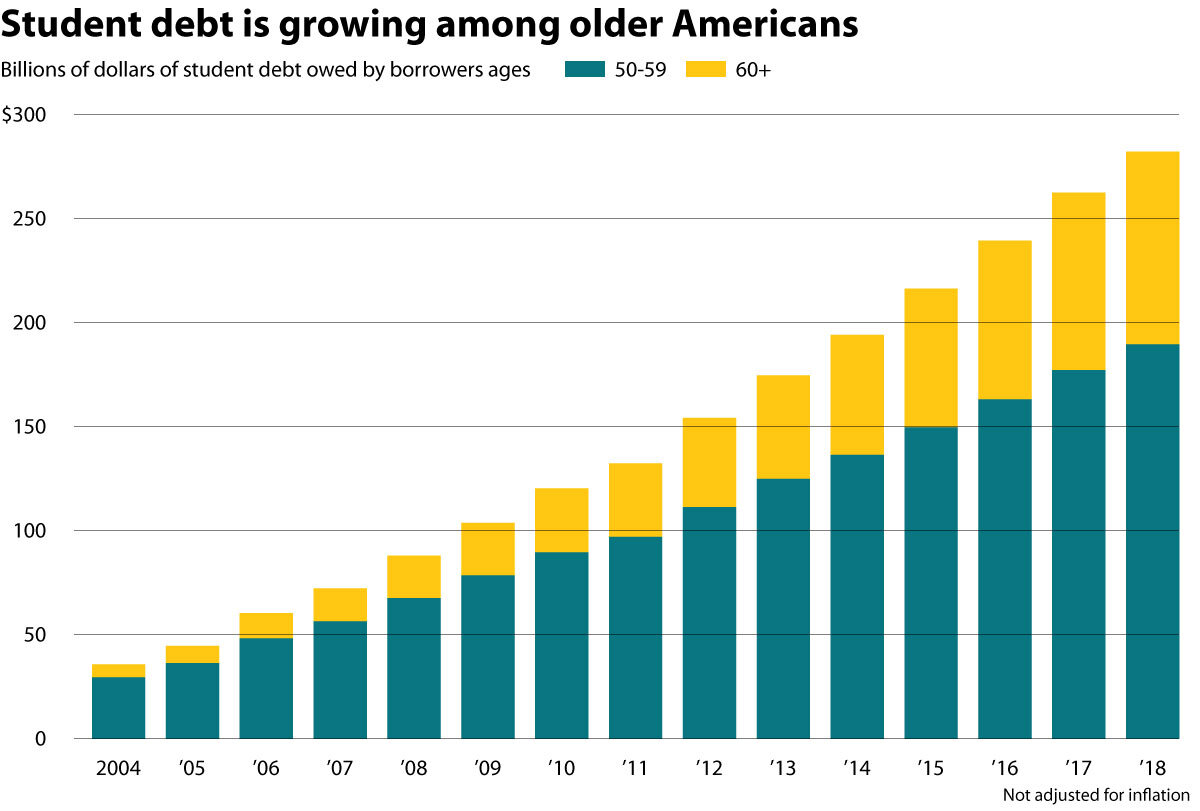
More And More Student Loan Debt Among Social Security Recipients

     The Christian Science Monitor has a nice article on the big and growing problem of student loan debt among those receiving Social Security retirement benefits. Here's a chart from the article showing just how big a problem it is.
     Unlike other debts, student loan debts can be collected by garnisheeing Social  Security benefits.
     I don't know the entire solution but I'm sure part of it is to make tuition at public universities more reasonable and to have public universities offer more distance education. There's too much student loan debt generated by questionable for profit education enterprises. The private for profit sector does a lot of things well but I don't think education is one of them.