Jun 7, 2021

Coming Today

      The government's brief in U.S. v. Vaello-Madero, a case pending at the Supreme Court, is due today. The issue in Vaello-Madero is whether it's constitutional to deny Supplemental Security Income (SSI) benefits to U.S. citizens who reside in Puerto Rico and other territories.

     President Biden has expressed support for legislation extending SSI to territories but there is little hope that legislation will pass. His Administration has not yet taken a position in Vaello-Madero

     The traditional principle has been that the Solicitor General, who handles cases for the federal government at the Supreme Court, should defend the constitutionality of any statute. Even before Trump came to office there had been exceptions to this princriple. The Trump Administration completely abandoned the tradition of defending the constitutionality of legislation it opposed. Joe Biden is a very traditional President but this case provides a strong temptation to abandon tradition. 

     The Solicitor General has already obtained two extensions of time to file a brief. In support of the last request for an extension of time, the Solicitor General said that "the brief requires consultation with a number of components of the government." 

     Extending SSI to Puerto Rico would be a big deal. There have been estimates that several hundred thousand people could qualify for benefits. Handling all those claims with no phase in and no time to prepare would be an enormous logistical challenge for the Social Security Administration that would affect operations across the entire country.

     Update: The government hasn't yet filed its brief but the President has released a statement saying that although he believes that SSI should be available in territories that his Administration will follow the conventional practice and defend the constitutionality of the statute.

     Further update: The Solicitor General had finally filed a brief. Don’t expect anything original in the brief. There’s a lot of talk about the income tax not applying to Puerto Rico and stare decisis.

Jun 6, 2021

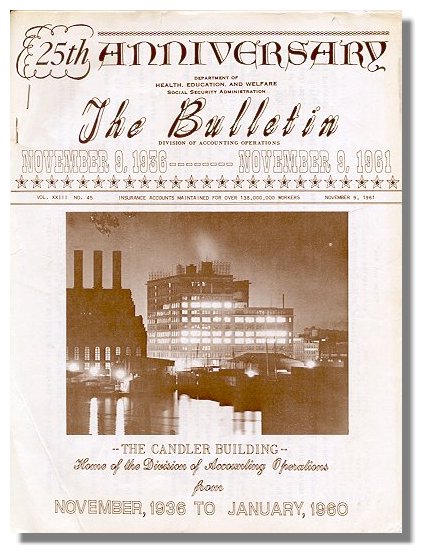
Social Security’s First Home


Originally built for Coca Cola, the Candler Building in Baltimore was Social Security’s  first home

Jun 5, 2021

I Can’t Quite Figure An Explanation For This One

      From WKMG:

ORLANDO, Fla. – The Social Security Administration claimed a survivor of the Pulse nightclub shooting in 2016 was never eligible to receive disability benefits, despite being shot several times and unable to work.

Tony Marrero said the agency sent him letters claiming he had to refund the money, which amounted to $20,792. ...

Marrero said he endured several surgeries and a lot of pain after a gunman stormed the Orlando nightclub on June 12, 2016.

“I got shot four times in my lower back. The muscle was completely shattered and I had a hole in my back,” he said. “My left arm was completely shattered. I was supposed to lose this arm, but I didn’t give up, and I told the doctors to give it some time because I have movement in these two fingers.”

Marrero said his injuries prevented him from going back to work at one of the area’s theme parks.

“I could not work. I was out of work for a year-and-a-half,” he said. “I wasn’t able to walk. I wasn’t able to use this arm properly. Notw only that, I worked at a theme park, so psychologically and mentally, I wasn’t prepared to be around big crowds.” ...

Soon after he was cleared to return to work, Marrero said he started receiving letters from the Social Security Administration, which read: “Our records show you were not entitled to disability benefits.” ...

The agency claimed Marrero owed all of the money back and they also dinged his credit report, which has now prevented him from getting a mortgage. ...

News 6 contacted the Social Security Administration to ask why Marrero was retroactively denied benefits. ...

One day later, the agency contacted Marrero and said they were reopening his case. ...

One week later, Social Security contacted him again and told him they were clearing the $20,000 debt. ...

Jun 4, 2021

Hard To Think Of A Title For This One


      From the Bangor Daily News:

New allegations that late artist Robert Indiana sexually abused teenagers in the 1980s came to light during a Waldoboro man’s sentencing for Social Security fraud. 

Wayne Flaherty, 53, claims the unreported income he received from 2000 through 2018 outside of his Social Security checks came as “hush money” from Indiana, the Portland Press Herald reported.

Flaherty pled guilty in January and was sentenced to three years of probation with 240 hours of community service and ordered to pay the Social Security Administration $141,214 on May 20.

Flaherty’s lawyer, David Beneman, said in his sentencing memo that the more than $846,000 Flaherty received during that period was intended to keep him quiet about alleged sexual abuse that started when Flaherty was a teenager in the 1980s, the paper reported. ...

Jun 3, 2021

"Close Proximity Of Time"

      A newly posted notice from the Office of Management and Budget about proposed regulations filed seeking approval:

AGENCY: SSA RIN: 0960-AI64 Status: Pending Review
TITLE:Flexibility in Evaluating "Close Proximity of Time" due to COVID-19-Related Barriers to Healthcare
STAGE: Interim Final Rule ECONOMICALLY SIGNIFICANT: No
RECEIVED DATE: 05/28/2021 LEGAL DEADLINE: None  

Jun 2, 2021

Final Work Reentry Plan Required By July 19

     From Government Executive:

The Biden administration is asking agencies to submit by July 19 finalized plans for returning federal workers to their offices.  ...

“Agencies will need to have finalized their plans for both reentry and post-reentry procedures and policies by July 19,” said a task force email to agencies on Tuesday, sent in collaboration with the Office of Management and Budget, the Office of Personnel Management and the General Services Administration. “Agencies may submit earlier at their discretion.”

The plans should build off the draft versions that need to be submitted to OMB by June 18 and must include phased reentry schedules and other safety measures informed by current guidance from the Centers for Disease Control and Prevention, the task force, the Occupational Safety and Hazards Administration and any other relevant guidance, the email said.  ...

The task force also said agencies must “satisfy applicable collective-bargaining obligations and provide ample notice to any employees who will be returning to the physical workplace, who will have altered work schedules, or who will otherwise have altered work circumstances, consistent with the agency’s intended post-reentry work environment.” ...

Axios reported on Tuesday that White House offices will bring back all employees in person between July 6 and July 23, with some exceptions.  ...


Jun 1, 2021

FTEs -- This Year And Next

      The Biden Administration has released its entire Fiscal Year (FY) 2022 Budget proposal. We already knew that it would call for a big hike in the agency's administrative budget, from $13.7 billion to $14.8 billion, an 8% increase but the entire proposal goes into much greater detail. The part that interests me is the projected number of Full Time Equivalent (FTE) employees (page 1,241).  The proposal shows the FTE number for FY 2020 as 59,574 (actual), for FY 2021 (estimated) as 59,355 and for FY 2022 (projected) as 60,586. 

     A couple of things stick out. First, overtime only went down by 0.4% between FY 2020 and FY 2021. If there's been a decline in performance at Social Security, in general, it's not because of a lack of overtime. In fact, with the amount of overtime almost stable, one would expect an improvement in performance since there are fewer time-consuming disability claims being filed. However, I've seen the opposite from the field offices and the payment centers with backlogs going up substantially. Hearing office performance hasn't been negatively affected but their workloads have been way down.  Second, there's an increase of 1,231 FTEs or 2% from FY 2021 to FY 2022 projected if Social Security gets the entire appropriation recommended. I don't understand. The budget goes up by 8% but the number of FTEs only goes up by 2%? Where's the rest of the money going? Will we once again see an increased operating budget drained away by IT? Of course, IT is needed but you have to have some balance with current operations. These projections tell me that Social Security management is largely unconcerned with public service.

     Update: There was a comment posted saying that federal FTE numbers do not include employee overtime. It doesn't make sense to me to compute FTEs that way, especially for Social Security which usually uses a lot of overtime, but that's the way they do it.

May 31, 2021

May 30, 2021

It’s A Disgrace

      Senator Bill Cassidy (R-LA) believes that federal employees, including Social Security employees have been sitting at home doing nothing while being paid over the last year. Apparently, he received a letter from Andrew Saul blaming employee unions for poor service at Social Security.

May 29, 2021

Service Delivery During And After The Pandemic

      From the New York Times:

When the pandemic struck last year, the Social Security Administration shut down its national network of more than 1,200 offices as it scrambled to protect the public and its employees from the coronavirus. ...

The agency is slowly bringing back workers in accordance with safety guidelines established by the federal government.

But operations are not likely to look the same as they did prepandemic, and a segment of S.S.A. workers may continue working remotely, a significant shift for the agency, which paid benefits to 69 million Americans in 2019. ...

Social Security’s consideration of a larger role for telework is a sharp departure from its stance in November 2019, when it ended a work-from-home pilot program. ...

There has been a sharp drop in applications for S.S.I., and for disability insurance. ...

While a great deal of routine Social Security business is now transacted via its website, field office staff provide in-person assistance on complex matters, in particular on applications for disability insurance and S.S.I., says Manasi Deshpande, an assistant professor of economics at the University of Chicago.

“Especially for people with lower socioeconomic status, being able to get in-person information and assistance with the application is critical to their decision to apply,” Dr. Deshpande said. “Without it, they just don’t apply.” ...

In the 10-year period Dr. Deshpande studied, Social Security closed 118 field offices, a cost-cutting move. She estimated that during that period, a total of 786,000 applicants for disability insurance and S.S.I. were discouraged from applying.

The impact of closing all field offices during the pandemic has been far greater, Dr. Deshpande said. “You’d probably need to multiply the estimates from the paper by a few times to see the effect of closing all the offices,” she said. “The 10 percent decline we measured took place with neighboring offices absorbing some of the applicants. It’s likely a much larger effect with all the field offices closed.” ...

Agency data shows a 29 percent decline in S.S.I. awards from July 2020 to April 2021 compared with the same period a year earlier, and disability awards are down 17 percent over that period. Taken together, up to 330,000 people will miss out on these benefits over a one-year period, according to an analysis of agency data by David Weaver, a former associate commissioner in Social Security’s Office of Research, Demonstration and Employment Support. ...

Social Security has a $1.5 billion budget for “program integrity,” but Congress limits that spending to reviews of disability awards that are aimed at removing people from the benefit rolls.

“A more common sense definition of program integrity would include the idea of making sure that people who are eligible for benefits are receiving them,” Mr. Weaver said. ...