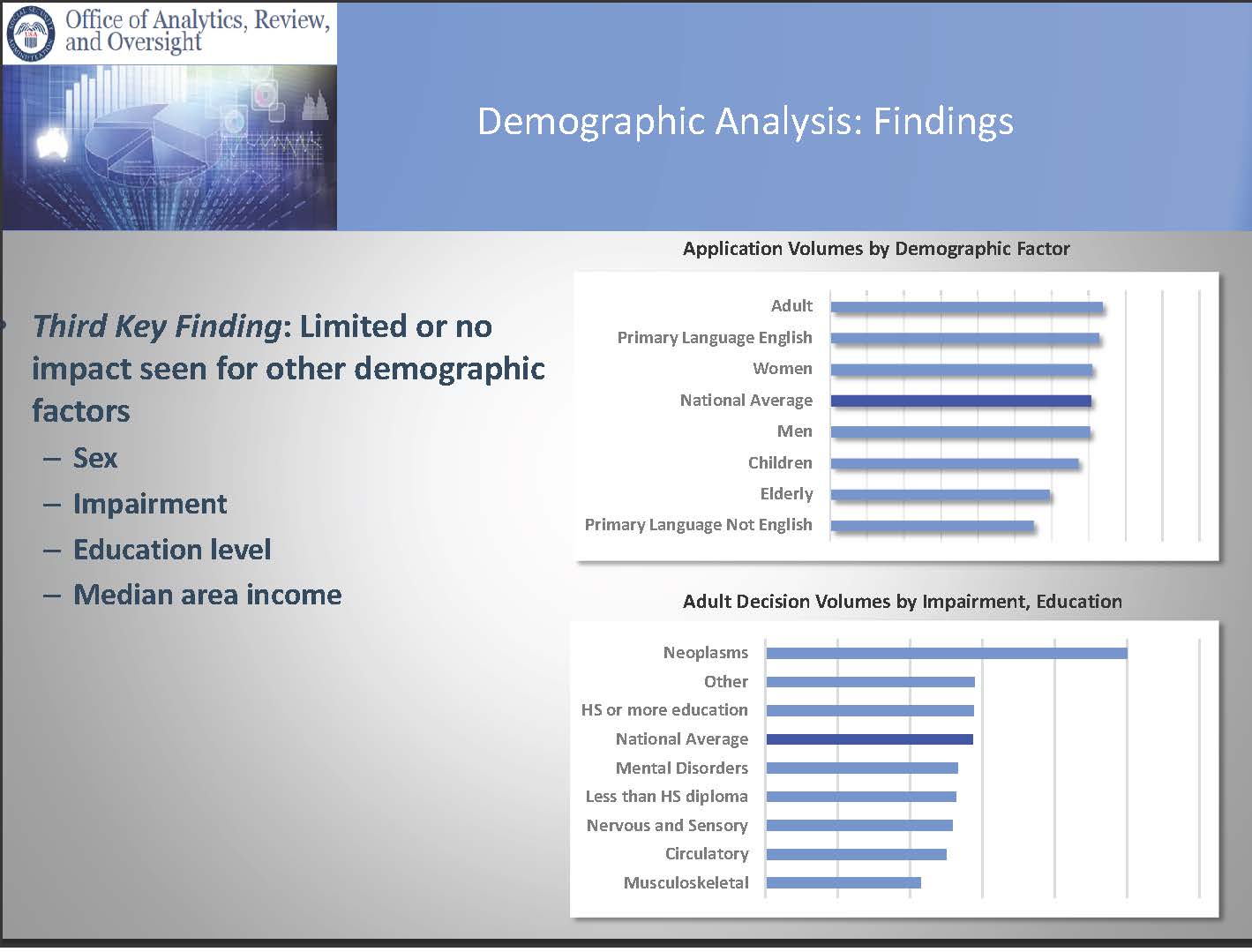
This slide deck was obtained from Social Security by the National Organization of Social Security Claimants Representatives (NOSSCR) and published in its newsletter, which is not available online
to non-members. Click on each to view full size.
Nov 17, 2020
Analysis Of Reduction In SSI Claims Filed Since Field Offices Shut Down
Nov 16, 2020
I'm Surprised By The Amount Of Overtime In The Third Quarter
This was obtained from Social Security by the National Organization of Social Security Claimants Representatives
(NOSSCR) and published in its newsletter, which is not available online
to non-members. It is basic operating statistics for Social Security's
Office of Hearings Operations.
![]() |
| Click on image to view full size |
Nov 15, 2020
Issuing A Directive
Today, House Ways and Means Social Security Subcommittee Chairman John B. Larson (D-CT) and Worker and Family Support Subcommittee Chairman Danny K. Davis (D-IL) sent a letter directing the U.S. Department of Labor to halt consideration of a proposed transfer of the Ticket to Work program from the Social Security Administration to the U.S. Department of Labor. The Ticket to Work program provides services to help Social Security and Supplemental Security Income disability beneficiaries who are attempting to return to work.
“In 1999, Congress placed the new Ticket to Work and Self-Sufficiency program (Ticket program) under the Social Security Administration (SSA), because of the close coordination between SSA and program participants, including beneficiaries and service providers, that is essential to the operation of the Ticket Program. Nothing has changed to warrant a transfer to the Department of Labor (DOL),” wrote Larson and Davis.
“By law, the Department of Labor does not administer the Ticket program,” continued Larson and Davis. “We do not intend to consider legislation to remove the administration of the Ticket program from SSA and place it at DOL. We therefore expect the Department to halt any further consideration of this inappropriate and detrimental proposal.”
Nov 14, 2020
Opposition To AAJ Hearings
Today, Ways and Means Committee Chairman Richard E. Neal (D-MA), Social Security Subcommittee Chairman John B. Larson (D-CT), and Worker and Family Support Subcommittee Chairman Danny K. Davis (D-IL) released the following statement after the Trump Administration announced it would finalize a rule on December 16, 2020 to change the Social Security Administration’s appeals process by replacing independent and impartial Administrative Law Judges with internal agency lawyers:
“For nearly two years, we’ve sounded the alarm that this change would erode due process for Social Security and Supplemental Security Income applicants and beneficiaries and threaten their access to their earned benefits. The rule puts unqualified agency staff in control of deciding appeals hearings and contradicts the congressional intent of the law governing such proceedings. We condemn this political decision that will go into effect just as the Trump Administration is on its way out the door. It is our hope that the Biden Administration rights this grievous wrong and ensures that all those who are eligible can access their disability, retirement, and survivors’ benefits.”
No mention of the Congressional Review Act.
Nov 13, 2020
Regs On AAJ Hearings To Go Into Effect On December 16
Monday's Federal Register will contain new final regulations from Social Security on Hearings Held by Administrative Appeals Judges of the Appeals Council. You can read the regulations today. The effective date is December 16. I do not expect that these regulations will be implemented during the Biden Administration. It is possible that they will be disapproved under the Congressional Review Act. Neither a filibuster nor the Senate Majority Leader can prevent a Congressional Review Act vote.
The explanatory material published contains this sentence (emphasis added): "Because AAJs and ALJs have similar levels of training, will follow the same set of policies, and have equivalent decisional independence, we anticipate that when AAJs are used at the hearing level, they will provide the same level of service and fairness as ALJs do." I can't say that I take that statement at face value. In fact, if true, I don't know what the point of these regulations is.
Nov 12, 2020
Final Musculoskeletal Listings Changes Approved
The Office of Management and Budget (OMB) has approved final regulations to modify Social Security's Listing of Impairments on musculoskeletal disorders. This proposal had been pending at OMB since last December, an extraordinary length of time. We don't know what's in the approved final regulations, although it's unlikely to be much different from the proposal. Expect to see these published in the Federal Register in the near future.
The proposal was extremely controversial. Musculoskeletal disorders produce a lot of disability. There's no doubt that the proposed regulations would have a significant effect upon who gets approved for disability benefits and that the intention was to sharply reduce the number approved. My opinion is that these regulations will prove to be the most enduring legacy of the Trump Administration as far as Social Security is concerned and that it will be a harsh legacy.
In theory, these regulations could be reviewed under the Congressional Review Act. It would only take a majority vote in both Houses of Congress plus the incoming President's approval to ditch these. No filibuster is allowed. However, these may seem too technical to get voted down. Also, if regulations get voted down under the Congressional Review Act, it takes Congressional approval to ever revive them. That could make it difficult for Social Security to ever modify the musculoskeletal Listings.
I would say that under normal circumstances Social Security would like to have considerable lead time in order to implement something of this magnitude and might make them effective further out in the future than the minimum 30 days notice. However, I don't think that those behind these regs expect to be around for the implementation or care much about proper implementation. For them, it's smash and grab time.
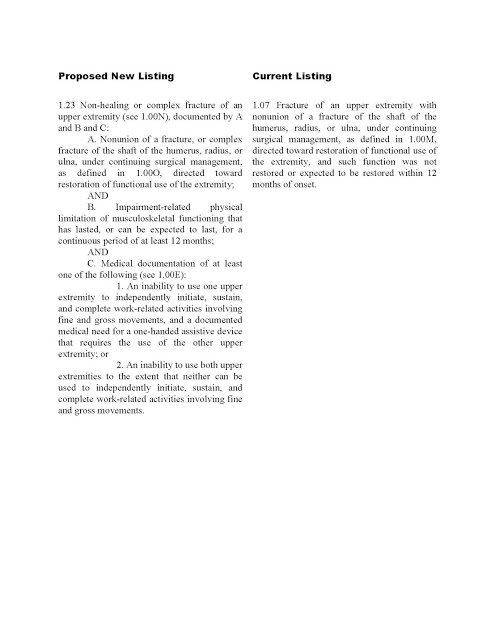
Below is a side by side comparison of the proposed regulation and the current regulation. Click on each to view full size. There was also an extensive preamble to the proposed regulations.
![]() |
| Click on each image to view full size |
Final Approval Requested For CDR Regs
Almost a year ago, Social Security published proposed regulations on continuing disability reviews. They propose to add a new category fro reviews, Medical Improvement Likely (MIL), to be reviewed every two years. MIL was aimed at a group of impairments which they said fitted between the categories of Medical Improvement Expected (MIE) and Medical Improvement Possible (MIP). They said they would include anxiety related disorders in this category. They proposed to increase the frequency of reviews for the category of Medical Improvement Not Expected (MINE) from seven years to six years. Overall, they said they expected to increase Continuing Disability Review (CDRs) by more than 1.1 million a year. This proposal encountered considerable opposition.
Social Security has now asked the Office of Management and Budget (OMB) to give approval to these as final regulations. OMB won't have long to act on the proposed final regulations. Traditionally, new Administrations put a freeze on any regulations still pending at OMB as well as new regulations that have been published but which have not yet gone into effect. Since agencies have to give at least 30 days notice, by my calculation Social Security needs to get these regulations in the Federal Register by December 21 to have them become effective before Joe Biden takes office. Even if they meet this timeline, the new Administration can refuse to implement them and the new Congress can review them under the Congressional Review Act. There are no filibusters of Congressional Review Act reviews.
Biden Transition Team For Social Security
President Elect Joe Biden has released the names of the members of his transition team for the Social Security Administration:
| Name | Most Recent Employment | ||
|---|---|---|---|
| Carolyn Colvin, Team Lead | Self-employed | ||
| Scott Frey | American Federation of State, County and Municipal Employees | ||
| David Holmes | Rebellion Defense | ||
| Jack Smalligan | Urban Institute | |
Colvin is, of course the former Acting Commissioner of Social Security. I could have predicted her as the Team Lead a year ago. I could also have predicted a union official on the team a year ago. Holmes is an Engineering Manager who has worked on projects at Social Security. Smalligan has promoted a "Work Disability–Functional Assessment Battery (WD-FAB)" which "uses item
response theory and computer adaptive testing to quickly interview
people and systematically map physical and mental health functioning."
It's not impossible for one of these people to end up with a job at Social Security but that's not the purpose of a transition team. I'd guess a job at Social Security for a member of this team is unlikely, but who knows, maybe Colvin would be interested.
Nov 11, 2020
Nov 10, 2020
Supreme Court Agrees To Hear Social Security Cases
The Supreme Court has agreed to hear Carr v. Saul and Davis v. Saul, two cases presenting the issue of whether the federal courts can consider Lucia objections to Administrative Law Judges (ALJs) having heard cases before the Social Security Administration when those objections had been raised administratively. The Supreme Court held in Lucia v. SEC that ALJs were unconstitutional since they had not been appointed by the agency head. Since that time they have been.
My opinion is that it's nuts to expect claimants to have raised Lucia objections when the Social Security Administration's stated position was that it wouldn't consider Lucia objections. It's also nuts because the Supreme Court had previously held that it was not necessary to raise other sorts of objections in Social Security cases administratively before raising them in the federal courts.
It's possible but I imagine unlikely that the new Solicitor General for the Biden Administration could decide to settle these cases before they're heard.
Nov 9, 2020
Do People Retire Later If They Receive Frequent Mailings Of Social Security Statements?
From Can Informational Interventions Be Effective Policy Tools? An Initial Assessment of the Social Security Statement by Barbara A. Smith, published in the Social Security Bulletin:
The Social Security Administration employs an informational intervention—mailing Social Security Statements—to inform workers about their potential benefits. I use linear probability models and agency administrative data to analyze the effect of Statement receipt on the age at which workers claim their Social Security retirement benefits. I compare results for individuals who received one or multiple Statement mailings by age 62 with those who received none during the 1975–2007 study period. I find that workers who received multiple Statement mailings were significantly more likely to claim retirement benefits at later ages than were other workers, and that Statement receipt is positively associated with employment at ages 62–70. I also compare the relative effects of an educational outreach (Statement mailings) and a direct policy change (involving the full retirement age) on claiming behavior and find that the magnitudes of the two effects are similar.
Nov 8, 2020
Early Retirements Declining
From Sean Williams writing in the Statesville Record and Landmark:
... Between 1995 and 2016, more than 70% of retired workers receiving a [Social Security retirement]benefit had their payout reduced for early retirement. ...
But as of December 2019, 67.3% of the close to 45.1 million retired workers receiving a benefit had their payout reduced. That marks the ninth consecutive year that early retirees declined as a percentage of total retired workers. ...
Nov 7, 2020
Nov 6, 2020
Union Claims Bias In Performance Appraisals
From Government Executive:
A union representing employees at the Social Security Administration this week accused the agency of failing to correct systemic bias in its performance appraisal process, in which white employees are receiving the lion’s share of top ratings despite making up less than half of the frontline workforce in recent years.
Officials with the American Federation of Government Employees said that management has been aware of the issue since at least 2015, when it agreed to settle a grievance with the union over the distribution of top performance ratings, but aside from two preliminary meetings, the agency has taken no action to correct the disparity.
According to data provided to Government Executive, in fiscal 2014, minority employees made up 54.3% of AFGE’s bargaining unit, but accounted for only 36.2% of the bargaining unit’s “Outstanding” performance ratings. The largest minority group—Black workers—accounted for 30.3% of the bargaining unit, but only 21.7% of top performance marks.
And while Latino employees made up 16.4% of the bargaining unit, only 8.7% of “Outstanding” ratings went to Latino workers. Similarly, while 10.5% of frontline employees at the agency have a disability, they only accounted for 5.5% of top ratings. ...
Social Security Administration spokeswoman Nicole Tiggemann said the union’s method of aggregating appraisal data is “not statistically valid,” because it does not “account for job type, employee experience and many other factors.”
[The Union president] said that in six years of filing grievances, Tiggemann’s statement is the first he has heard of the agency disputing the data management had provided. ...
Nov 5, 2020
Happens All The Time
From CBS News:
Mary Hutson of Santo, about an hour west of Fort Worth, began teaching elementary school students in 1963.
Now, the great-grandmother sits and reads with her great-grandchildren and teaching them.
Hutson is very involved with her family.
She is very active.
And, she is very much alive as she explained staring into a zoom call, hair fixed perfectly, smiling from ear to ear with pink lipstick glowing. ...
But a couple of months ago, she was dead according to the government. ...
In June, Hutson’s brother passed away.
When she reported his death to the Social Security Administration, she says she somehow also ended up “deceased” according to records. ...
Particularly during a pandemic, both Hutson and Tuckett [another person who had also been wrongly declared dead] say “coming back to life” is not easy. They both had to visit the social security office in person. They then had to wait for every entity tied to that that magical nine-digit number to bring them back to life. ...
“I was glad they recognized that I am still on earth,” laughed Mrs. Hutson looking down at a letter from the Social Security Administration which she finally received stating that she is alive. “I’m old, but I’m still here.”
Nov 4, 2020
If You Can Use Digital Signatures, Why Can't We?
From a Social Security newsletter (emphasis added):
We are required to conduct continuing eligibility reviews for disabled beneficiaries every three years. This process requires that beneficiaries complete a Continuing Disability Review mailer to update information about their medical conditions and recent treatments.
We now offer an online option to complete this update and provide any supporting documents about your medical treatment or your work.
We designed this new form with convenience in mind—and to save you time. You can access the online form at www.ssa.gov/ssa455-online-form. (Use either Microsoft Edge or Google Chrome for the best online experience.) ...
Once you “Click to Sign,” you will receive an email from echosign.com asking you to confirm your digital signature. Check your junk folder if you don’t receive it within a few minutes. Your signature isn’t complete—and your form won’t be processed—until you complete the instructions in your email.
I think this is the first time I've seen Social Security accepting digital signatures. Attorneys have been complaining for some time that Social Security won't accept digital signatures on documents submitted by attorneys.