Sep 11, 2015

Study On Child SSI For Mental Illness

     The Institute of Medicine (IOM) has released a 394 page report on Supplemental Security Income (SSI) for children with mental disorders. The study was commissioned by the Social Security Administration. Here are some findings from the report that stuck out to me:
  • The percentage of poor children drawing SSI decreased from 2004 to 2013. 
  • The total number of children drawing SSI increased from 2004 to 2013. The increase in the number of children receiving SSI due to mental illness closely matched the increase in the number of children receiving SSI due to physical conditions.
  • Roughly 60% of children who are likely eligible for SSI due to intellectual disability receive SSI. The percentage is decreasing. At the same time there has been a significant increase in the number of children qualifying for benefits due to autism spectrum disorder. These two trends may be related. Children who once would have been diagnosed with intellectual disability are now diagnosed with autism spectrum disorder.
  • Only about 3% of children who are potentially eligible for SSI benefits due to a mood disorder (usually bipolar disorder) are receiving SSI benefits.
  • Approximately half of all children receiving SSI were found disabled due to a mental disorder.
  • There is considerable variation from state to state in the rate at which SSI claims are filed for children based up on mental illness and the rate at which these claims are approved. The number of claims approved per 100,000 poor children ranges from 107 in Nevada to 744 in Pennsylvania. There's a pronounced geographic tilt. A far greater number of children apply for and qualify for benefits in the Eastern half of the United States than the West. I really wish that I could display the chart and map here but the report in a format that makes this impossible, at least for me. They're on pages 76 and 77 of the report. If you go to the report, do not miss these pages!
  • Between 2004 and 2013 the average rate of child SSI determinations decreased by 2%. However, the rate increased by 48% in Rhode Island but decreased by one-third or more in Minnesota, North Dakota, Kansas and Nevada. 
  • Diagnosis of mental illness was significantly more common in white children than in African American or Hispanic children. The rate was lowest for Asian-American children.
     Update: A reader was kind enough to help in getting pages 76 and 77 into a format I can post here. Click on each to view full size.


Sep 10, 2015

Guilty Plea In Philadelphia

     There has been a guilty plea in the Philadelphia case of a woman accused of holding disabled adults in captivity so that she could, among other things, steal their Social Security disability benefits.

Number Drawing Disability Benefits Continues To Decline

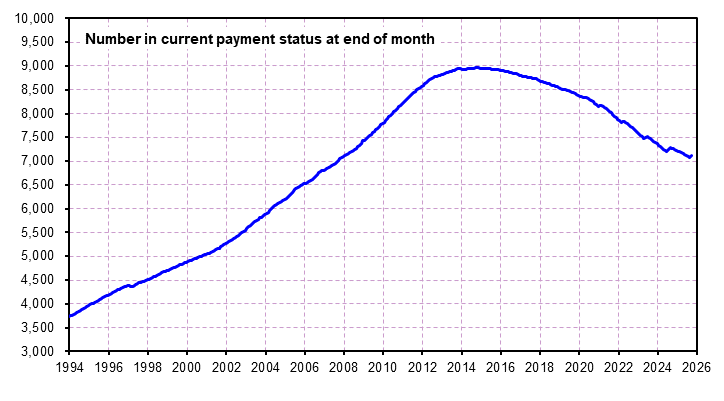
     The number of people drawing Social Security disability benefits declined in August. This number has declined in ten of the last eleven months.

Sep 9, 2015

Setting The Table?

     Dylan Scott, writes in the National Journal that the Social Security disability "reform" under consideration as the Republican "price" for extending the life of the Disability Trust Fund is some change in work incentives. The problem is that such a change probably won't save money and may end up costing money. Maybe more important, changes under consideration could work as a disincentive to return to work. Still, if work incentives are the only thing on the table, agreement should be possible. Are work incentives the only thing that Republicans intend to put on the table or merely the first thing? Will the controversial changes be revealed only after the 2016 election?

Sep 8, 2015

ALJ Removed For Low Productivity

     Mark Shapiro was hired by the Social Security Administration as an Administrative Law Judge (ALJ) in 1997. Throughout his career as an ALJ Shapiro failed to meet agency productivity standards. He averaged about 10-12 decisions a month while the agency was expecting around 50 a month. Shapiro was given additional training and many warnings but his productivity remained low. Finally, the agency asked the federal Merit Systems Protection Board (MSPB) to remove Shapiro from his position as an ALJ. The MSPB agreed to remove Shapiro from his job. Shapiro appealed to the U.S. Court of Appeals for the Federal Circuit. That Court has affirmed the MSRP decision.
     My view is that the agency standard of 50 or more decisions a month is somewhat too high. However, 10-12 decisions a month is way too low. I don't know what Shapiro's problem was but he had no business being an ALJ. My advice for any ALJ struggling to get out, let's say, 35 decisions a month, is to find something else to do. ALJ positions aren't some calling from God. They're jobs. It's not a job for everybody. Life is too short to spend years working at a job you aren't cut out for.

Sep 7, 2015

Off Topic: Spooky

     I got a call from a telemarketer yesterday. Nothing unusual about that other than it was Sunday, but, still, that's not all that unusual these days. The "do not call" registry is a joke. The unusual thing was that the caller asked for my mother, by name. My mother doesn't live with me. She died in 1979.

Happy Labor Day


Sep 6, 2015

Patent Applied For

A computerized system and method for determining eligibility for social security disability insurance benefits (SSDI) through a computer network. The network provides access to State databases containing information relating to persons receiving treatment for developmental disabilities and/or mental illness from a State licensed care facility and Federal Social Security records containing information relating to person's status of SSDI benefits and parental/marital information relating to person's eligibility of SSDI benefits. The system and method is programmed to automatically determine who is potentially eligible for SSDI benefits and determine those who are eligible for SSDI benefits based on the information identified within the State and Federal databases. Moreover, the computerized system and method may also automatically identify lump sum payments paid out on behalf of at least one person who is/are receiving treatment for disabilities and/or mental illness from a State licensed care facility.

Sep 5, 2015

Social Security Disability Insurance at Age 60: Does It Still Reflect Congress' Original Intent?

     Paul O'Leary, Elisa Walker, and Emily Roessel of Social Security's Office of Retirement and Disability Policy have written an article titled Social Security Disability Insurance at Age 60: Does It Still Reflect Congress' Original Intent? I won't hold you in suspense. Their answer is "Yes." 
     Having looked at the legislative history of Disability Insurance Benefits, I'd have to say that it's impossible to answer the question. The program now is dramatically different than when it started but those differences have to do with amendments to the Social Security Act rather than anything to do with its administration. Sixty years ago there weren't even any cash benefits, for goodness sake! Of course, it's changed.

Sep 4, 2015

Friday News Dump

     Social Security's Office of Inspector General (OIG) has issued a progress report on Social Security's national computer center. This is a very expensive project to replace Social Security's current data processing center. There has been a controversy over whether it's really needed.
     OIG has labeled the report as "Limited Distribution" and has issued only a very brief summary to the public. They're keeping most of it secret. The report, such as it is, has been released on the Friday before Labor Day. Why?
     Let me just mention that a Republican was Commissioner of Social Security when the national computer center was being planned and when construction started. Republicans on Capitol Hill were the biggest proponents of a national computer center. I don't think Social Security's Inspector General, who was appointed by President George W. Bush, has ever raised any question about the wisdom of creating a national computer center even though OIG has done many studies of the national computer center over the years. I don't think this is a partisan problem but if it is, it's a problem primarily created by Republicans.

Work Incentives Don't Matter Much

    The Center on Budget and Policy Priorities (CBPP) has issued a report on benefit offset proposals for Social Security's disability programs. To vastly oversimplify, claimants can now work for a year and earn as much as they can before their cash benefits are completely cut off. This is often referred to as a cliff. The idea would be to replace this cliff with a ramp. Benefits would be gradually reduced by earnings from employment instead of being suddenly cut off altogether. There are several proposals for how this ramp would work. CBPP's report shows that any benefit offset program would be problematic. CBPP is skeptical of any benefit offset proposal. 
     I think the current system is so ridiculously complicated that a change to a benefit offset system would be a good idea. There would certainly be problems with a benefit offset system but those problems are far less than the problems we have now. I don't think that CBPP comprehends just how difficult it is to administer the current system. I suppose those practical problems don't matter to you if you're sitting in a think tank in D.C. and never have to deal with implementing the preposterous mess we have now.
     The far more important point in the CBPP report is that anyone who thinks that tinkering with work incentives is going to save money doesn't understand the problem. It doesn't matter what work incentives are implemented, very few Social Security disability recipients will return to work.
     The belief that tinkering with work incentives could save a lot of money arises out of persistent confusion about who is drawing Social Security disability benefits. Here are the misconceptions:
  • Many people visualize Social Security disability recipients as having health problems that will get better over time when, in fact, very few do get better. The vast majority get worse as time goes along. You have to have been or be predicted to be disabled for at least a year to get on benefits. If you've got something wrong with you that's going to disabled you that long, it's almost certain to disable you for the rest of your life.
  • Many people think it's not too hard to get on Social Security disability benefits so many who get on benefits could work if they really wanted to. They just need appropriate incentives. Actually, it's incredibly difficult to get on Social Security disability benefits. Few people who get on benefits have any realistic hope of returning to regular, sustained employment.
    None of us want to think we'll become disabled. We're too strong, too hard-working for that to happen to us. That happens to other people. You know, those lazy people who don't want to work. You know who they are. We're not like them. No, if we get sick, we'll get better and we'll be back at work. It would take something catastrophic to disable us. If that happened, we're certainly not have any problems with Social Security and no one would think we'd ever be able to go back to work.  I get a lot of clients who used to think like this. In fact, they still think like this despite their problems getting on Social Security disability benefits. They think that their problems with Social Security are just some weird fluke. But, of course, disability won't happen to us. No, that happens to other people. You know who they are.

Sep 3, 2015

NCSSMA Newsletter

     The National Council of Social Security Management Associations (NCSSMA), an organization of Social Security management personnel has issued its September 2015 newsletter. The newsletter lists NCSSMA's legislative proposals:
  1. Eliminate SSI Dedicated Accounts
  2. Eliminate the SSI Holding Out Provisions among Couple 
  3. Streamline Worker’s Compensation Offset
     No, I don't know how they want to streamline the workers compensation offset.

Sep 1, 2015

"The Ticking Time Bomb" Of Social Security Disability

     Harold Pollack has a lengthy article in The Atlantic on what he refers to as "the ticking time bomb" of Social Security disability. It's a more sophisticated article than most. However, Pollack clearly spent a lot of time listening to right wing advocates who are on the payrolls of insurance companies. I don't understand why anyone would think that forcing individuals or their employers to purchase private disability insurance would be a plausible solution for anything. Honestly, I can't understand why the insurance companies think it makes business sense to invest even small amounts of money on a proposition whose adoption is so wildly improbable.
     Anyway, here are two interesting graphs from the article.

Aug 31, 2015

The Mess Left Behind By Eric Conn

One minor point: The reason that attorneys cannot get fees for representing claimants at these upcoming hearings isn't that Conn already got the maximum fee. The problem is that these claimants are still receiving benefits. No back benefits accrue from which an attorney can obtain a fee.

Aug 29, 2015

High Stakes In Disability Determination

     People drawing the British equivalent of Social Security disability benefits are being subjected to new examinations to determine whether they're really disabled. Many are being cut off benefits. It turns out that more than 80 a month of those cut off are dying shortly after being found not disabled.

Aug 28, 2015

The Hunt For Social Security Disability Villains

     From a report by Social Security's Office of Inspector General:
On December 12, 2014, we received a request from the Chairman of the Subcommittee on Social Security, Committee on Ways and Means, to provide information on how SSA ensures beneficiaries follow prescribed treatment. ...
We identified 15 instances where SSA [Social Security Administration] denied benefits — or removed a beneficiary from the disability rolls based on a CDR [Continuing Disability Reviews]— for failing to follow prescribed treatment. Of the more than 2 million disability denials in 2012, only 5 were denied because the individuals failed to follow prescribed treatment. Of the 122,000 initial CDR cessations in 2012, the Agency ceased 10 because the individuals failed to follow prescribed treatment. ...
Additionally, w e reviewed a sample of 200 initial claims allowed in 2012 and found 23 had a possible failure to follow prescribed treatment issue. In 22 of these 23 claims, the adjudicator processed the claim in accordance with SSA policy. However, in one claim, the adjudicator did not follow Agency policy since he/she did not develop a potential failure to follow prescribed treatment issue. 
We also reviewed a sample of 200 CDRs continued in 2012 and found 11 had a possible failure to follow prescribed treatment issue. In all 11 claims, SSA handled the issue in accordance with policy. ...
     Perhaps the interesting thing here is the request from the Chairman of the House Social Security Subcommittee. It seems to be part of a Republican search for Social Security disability villains. It is similar to the recent suggestion by one Republican officeholder that mothers were intentionally poisoning their children with lead in order to get free housing. Sorry, guys but you're not going to find claimants refusing medical treatment so they can be found disabled or remain disabled. That's virtually nonexistent. And, no, Social Security's failure to find instances of this happening doesn't mean that Social Security hasn't been looking for it. It's because it just about never happens.

Aug 27, 2015

Maine Congressional Delegation Reacts To The Hearing Backlog

     Maine's Congressional delegation is reacting to Social Security's vast and growing hearing backlog.

GOP Wanted FOIA Investigation

     Congressional Republicans asked Social Security's Office of Inspector General (OIG) to see whether political appointees at Social Security were manipulating the agency's responses to Freedom of Information Act (FOIA) requests. OIG found no evidence of this.
     I have no idea why the GOP would think there was a problem with political interference with FOIA requests at Social Security. However, there is a big FOIA problem at Social Security. FOIA requests at Social Security take forever! Months and even years can pass without a response. This isn't because of political interference. It's because of lack of resources. It's the same at other government agencies. FOIA is a mess but the problem isn't political.